
GOVERNANCE BOARD
The Governance Board works voluntarily and with total dedication, in order to effectively contribute to the strengthening of the South American environmental agenda. The group evaluates the entities recommended for funding by the staff and advisory committee. This process is carried out in an articulated and coordinated manner, which ensures a more comprehensive distribution of the grants. All members of the Board are notably experienced, with national and international recognition for their socio-environmental leadership.
MEMBERS

SELMA DOS SANTOS DEALDINA MBAYE
Chair of the Board -National Coordination of Articulation of Black Rural Quilombola Communities - CONAQ
Graduated in Social Work, Selma is originally from Sapê do Norte, in the Angelim III community in São Mateus, Espírito Santo, Brazil. Selma serves as Executive Secretary of CONAQ (National Coordination for the Articulation of Black Rural Quilombola Communities), Alternate Council Member for Racial Equality in Espírito Santo, and Full Council Member for Culture in Espírito Santo. She was part of the organizing team of the 2015 Black Women’s March within the Espírito Santo Mobilization Nucleus and is also a member of CONAQ’s National Collective of Quilombola Women.

Laura Yawanawa
Vice-chair of the Board - Executive Director of Yawanawá Socio-Cultural Association - ASCY
Laura Yawanawa is an indigenous leader with Zapotec and Mixtec roots from the Oaxaca region, Mexico. She holds a degree in International Relations, with a specialization in indigenous peoples' political affairs. She served as the Executive Director of the South and Meso-American Indian Rights Center in Oakland, California, where she tirelessly worked for the rights of indigenous peoples throughout Latin America. Laura co-founded organizations to support indigenous peoples, including the Nawa Institute and INIYA (Indigenous and Non-Indigenous Alliance). She also worked for the Acre State Institute of Climate Change, organizing workshops in indigenous communities to raise awareness about climate change and environmental services. For 17 years, she has been working for the Yawanawá people and is currently the Executive Director of the Yawanawá Socio-Cultural Association - ASCY.

BRENT MILLIKAN
Member of the Executive Secretariat of the Infrastructure and Socio-Environmental Justice Working Group
Brent Millikan holds a Master’s degree in Geography from the University of California, Berkeley (USA), and has extensive experience in initiatives related to infrastructure, regional planning, and socio-environmental sustainability, especially in the Amazon region. He lived for more than ten years in the state of Rondônia, where he worked as a researcher, consultant, and representative of the Institute for Amazonian Studies (IEA). Between 2000 and 2007, he worked at Brazil’s Ministry of the Environment (MMA), contributing to initiatives such as the Pilot Program for the Protection of Tropical Forests in Brazil (PPG7) and the Action Plan for the Prevention and Control of Deforestation in the Legal Amazon (PPCDAM). He has worked as a consultant for several multilateral organizations, including UNDP, ACTO, IUCN, and the World Bank. In recent years, he served as Director of the Amazon Program at International Rivers in Brazil (2010–2021) and as Advisor to the CASA Socio-Environmental Fund. More recently, he has participated in the Executive Secretariat of the Infrastructure and Socio-Environmental Justice Working Group and worked as a consultant with the Center for Sustainability Studies of Fundação Getulio Vargas (FGVces), Conectas Human Rights, the Institute for Socioeconomic Studies (INESC), the Institute for Energy and Environment (IEMA), and Latinoamérica Sustentable (LAS).

EDMILSON CARLOS PEREIRA DE ABREU PINHEIRO
Director of Fórum Carajás
Agronomist and licensed Biologist, with specializations in Environmental Management, Sanitation and Environmental Engineering, and Environmental Law. He began his work in social movements through the NGO Associação Agroecológica Tijupá and later served as Municipal Secretary of the Environment in Bequimão (MA). He is a co-founder of the Casa Socio-Environmental Fund. Currently, he collaborates with Fórum Carajás and the Quilombola Movement of Bequimão (MOQBEQ). He also serves as advisor and secretary of the Advisory Council of the Itapetininga Extractive Reserve (Federal Conservation Unit).
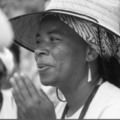
Elionice Sacramento
Association of Artisanal Fishers and Quilombola Communities of Conceição de Salinas
Elionice Conceição Sacramento is a black woman, belonging to the Filomena race. She is a fisherwoman by profession, tradition, and political decision, as she likes to assert. She is a militant of the National Artisanal Fishers Women's Articulation and the Fishers' Movement, and she is part of the coordination of the Association of Artisanal Fishers and Quilombola Communities of Conceição de Salinas. She holds a master's degree in Traditional Knowledge and Sustainability among Traditional Peoples and Lands from UnB (University of Brasília) and is a Ph.D. candidate in Anthropology. Sacramento is the author of the book "From the Black Diaspora to the Territory of Land and Waters - Ancestry and Women's Protagonism in the Fishers and Quilombola Community of Conceição de Salinas/BA" and co-author of other works such as "Salinas, the sea, the mud, and life."

ESALTINA GONÇALVES COSTA
Co-Founder of Unikebradas
Public speaker, manager, and social educator, mentor, social projects consultant, podcaster, partner at REinvento Consultoria, founder of the NGO Escadas, and co-founder of the projects Café das Marias and Unikebradas.

GISELE PAULINO REIS DE OLIVEIRA
Co-founder of UniDiversidade das Kebradas (UniKebradas)
A deconstructed journalist, she attended the best schools and wrote for Brazil’s leading newspapers. Yet it was her travels around the world and encounters with wise people that became her true university. Recognizing herself as part of a society that has been broken, she dedicates herself to stitching together different worlds, telling stories, and transforming lives. She lives on a small farm in Cunha, where she learns from nature while constantly bringing together worlds and their scattered pieces.

Iremar Ferreira
Director of Instituto Madeira Vivo
Iremar Antonio Ferreira, a popular educommunicator, has been working since 1988 in the defense and promotion of rights. He is currently the director of Instituto Madeira Vivo and a member of the Pan-Amazon Social Forum - FOSPA and the Forum on Climate Change and Socio-Environmental Justice - FMCJS, fighting for socio-environmental justice. He coordinates the Committee for the Defense of Amazonian Life in the Madeira Basin - COMVIDA, in Brazil and Bolivia. He holds a degree in History and a master's degree in Regional Development and Environment.

Mércia Silva
Executive Director of ESG Fractal - Human Rights in Supply Chains
Mércia Silva holds a degree in Social Sciences and a Master's degree in Political Science from the University of São Paulo (USP). She is a Fellow of the U.S. Department of State and Fulbright. She has extensive experience conducting field research focused on labor issues. Her personal and professional fight is to eliminate slave labor in Brazil. For 8 years, she served as Executive Director & Government Relations at InPACTO, a nonprofit organization that mobilizes companies (both public and private) from various sectors to prevent and eradicate slave and child labor in supply chains. Currently, Mércia is the Executive Director of ESG Fractal, a company focused on human rights in supply chains.