
 02.12.2025
“From Territory to Climate Action”: new Casa Socio-Environmental Fund publication reveals the strength of local responses
Third volume of the series Building Climate Justice shows how mitigation, adaptation, and a just transition are already happening on the ground.
Amid a global landscape focused on targets, models, and climate finance, one question remains without a clear answer: does the money actually reach the communities that live in—and safeguard—the most climate-vulnerable territories in Brazil?
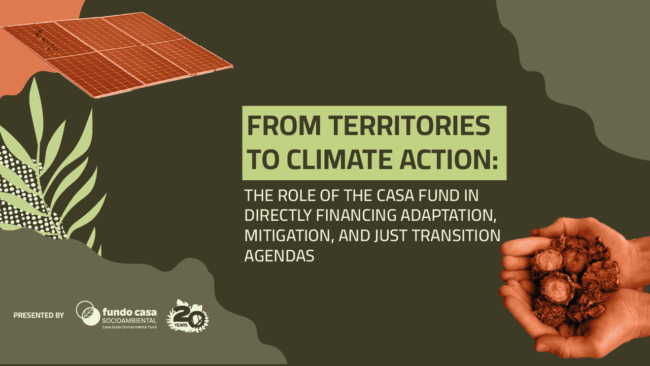
The Casa Socio-Environmental Fund’s new publication, From Territory to Climate Action: The Casa Fund’s direct financing for adaptation, mitigation, and just transition agendas, brings unprecedented data to answer this question with precision, transparency, and urgency.
The report, which concludes the Building Climate Justice series, systematizes 1,267 initiatives supported between 2022 and 2024, representing approximately R$100 million (US$20 million) transferred directly to grassroots organizations, Indigenous peoples, quilombola communities, and traditional populations. It offers a rare and necessary portrait of how climate finance works in practice when it reaches where it should: the territories.
The publication matters because it reveals, through concrete data, what social and environmental leaders have said for decades: solutions to the climate crisis already exist—and they emerge from the territories. What is missing is for resources to follow these pathways.
The study shows that adaptation is the central axis of supported initiatives, with actions in water security, agroecology, cultural strengthening, and territorial protection directly addressing the impacts of climate change already being felt.
Mitigation appears integrated into the daily lives of those who keep the forest standing, through community-led monitoring, ecological restoration, local recycling, and renewable energy solutions.
A just transition emerges as a cross-cutting dimension, present in income generation, low-carbon economies led by women and youth, and in the defense of rights and community autonomy.
Nearly half of the Casa Fund’s grants in the period analyzed combine mitigation and adaptation simultaneously—demonstrating that the categories debated in global forums are, in practice, inseparable for communities. And while the Amazon concentrates a significant share of resources, the publication calls attention to the urgent need to expand financing in historically neglected biomes such as the Caatinga, Cerrado, Pantanal, and Pampa.
Over two decades, the Casa Fund has become one of the few philanthropic mechanisms in Brazil able to transfer resources quickly, simply, and at scale to grassroots organizations. This publication shows that the Casa Fund works directly across the three major pillars of the international agenda: mitigation, adaptation, and just transition.
From Territory to Climate Action is the third and final volume of the Building Climate Justice series, which has become a reference by documenting how communities confront the climate crisis through nature-based solutions, local governance, and rights defense. For researchers, funders, public policy practitioners, or anyone seeking to understand how climate action takes shape across Brazil’s diverse territories, this publication is essential reading.