
 17.10.2025
Supporting communities is key to resisting the advance of fossil fuels
Oil advances and communities resist: learn how Casa Socio-Environmental Fund strengthens grassroots initiatives
Brazil is living through a moment of deep contradictions. On one hand, there are growing alerts about droughts, smoke, and forest fires already affecting millions of people in different regions. On the other, new oil and gas projects—both on land and offshore—are multiplying through announcements and investments. With COP30 taking place this November in Belém, these tensions gain even greater relevance, placing the country under global scrutiny and adding pressure to its climate and energy decisions.
The most recent announcement came from British company BP, which revealed its biggest discovery in 25 years, in a pre-salt block in the Santos Basin (SP). The energy market celebrated the news, but it brought an uncomfortable question: how can the urgent need for decarbonization coexist with the accelerated expansion of the fossil frontier?
From Maranhão to the Middle Juruá, passing through the Equatorial Margin, the promises of oil and gas wealth fade in the reality of the territories. There, where forest meets river and the land sustains communities, what the market calls “progress” arrives as a threat: weakened crops, polluted waters, and ways of life turned uncertain.
While official speeches celebrate new exploration cycles, it is these populations who experience, in their daily lives, the deepest and most unequal impacts of this energy model.
This dilemma is felt directly in the territories where Indigenous peoples, riverine communities, quilombolas, fishers, and family farmers struggle every day to protect their ways of life. The extraction of hydrocarbons threatens the water, land, fishing, and agriculture that sustain thousands of families.
“When we talk about oil and gas exploration in the Amazon, we are also talking about social, cultural, and environmental impacts. Communities are left without information, without consultation, and projects advance as if they were inevitable. But they are not. There is resistance, and there is local knowledge capable of saying no,” says Sila Mesquita, coordinator of the Amazon Working Group (GTA), who closely follows the realities of the Amazon region.
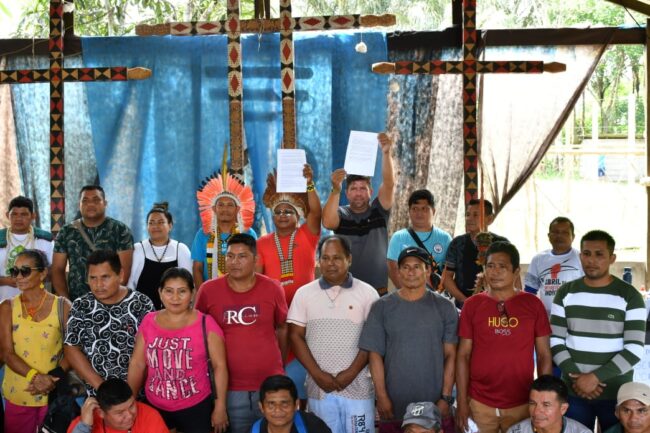
Indigenous leaders from Oiapoque take a stand in defense of the Amazon and the ocean, reaffirming their opposition to oil exploration at the mouth of the Amazon River. Photo: GTA Archives
Yet this resistance faces structural inequalities. While companies have large technical teams, political lobbying, and mass communication resources, communities must defend their rights with limited means. This is where the support of community-based socio-environmental philanthropy becomes crucial.
Since 2005, the Casa Socio-Environmental Fund has supported projects that strengthen leadership, connect communities, and shed light on risks often overlooked by the public debate. Over the years, the Fund has supported 64 initiatives in Brazil and other South American countries, focused on monitoring oil spills and contamination, providing legal assistance to those defending their territories, and strengthening community responses to socio-environmental threats—recognizing and empowering solutions that already exist within the communities themselves.
According to Sila Mesquita, “what’s at stake is the devastation of unique ecosystems and a direct attack on Indigenous, riverine, quilombola, and small farming communities.” She adds that the extraction advances in the name of so-called development, which in practice means destruction and wealth concentration. “We are witnessing a war against the Amazon and its peoples, waged in the name of false development, but which is in fact pure destruction,” she states.
In this context, supporting communities and local organizations has been essential to confront the risks. Funding independent technical studies, for example, helps dismantle the official narratives of companies and governments, exposing the irreversible impacts of hydrocarbon extraction. Moreover, political and technical training projects have strengthened leaders who now resist not only corporate pressure but also the weight of state machinery.
Sila Mesquita stresses that it is fundamental for this struggle to be broadly represented—showing not only the vulnerabilities but also the strength and vision of the Amazonian peoples.
“We cannot speak of the Amazon in abstract terms. People live here, and their lives depend on the integrity of their territories. And let’s be clear: there can be no true energy transition unless it is also a social, anti-capitalist, and deeply democratic transition—built from the ground up by the peoples who have cared for this forest for millennia.” Sila Mesquita, Coordinator, Amazon Working Group (GTA)
Socio-environmental philanthropy strengthens communities in Maranhão against the impacts of the gas industry
In Maranhão, the Vale do Mearim region and the state’s western coast are the stage of a quiet but decisive struggle for the future of hundreds of families. On one side, the expansion of the natural gas industry—with pipelines and storage terminal projects. On the other, quilombola, forest-dwelling, and riverine communities resisting to secure their right to remain in territories inhabited for centuries.
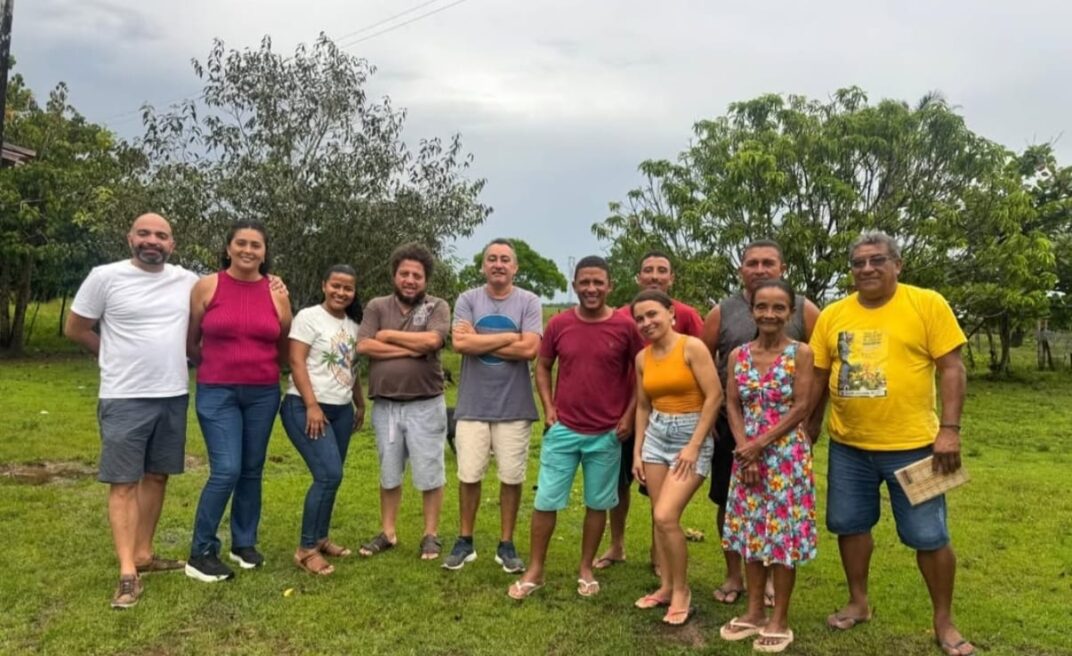
In the Papagaio community, in Santa Rita (MA), residents face uncertainty over Eneva’s plan to build a pipeline to transport gas from the Vale do Mearim to the port area of São Luís.
The situation is not isolated. Maranhão has long faced pressure from major ventures—from agribusiness to mining, ports, and highways. Now, under the promise of gas as a “transition fuel,” the state finds itself at the center of Brazil’s energy dispute. But for the communities, the modernization discourse does not compensate for the risks.
“The federal government treats gas as a strategic resource and paves the way for companies. But those living in the territories are rarely heard. It’s common to see communities complaining, but no one listens. Our role is precisely to collect information, produce materials, and organize meetings and seminars so that these voices gain strength and can influence the process,” explains Mayron Borges.
The project includes research, community meetings, and the production of informative materials about the impacts of the gas industry. Around 500 people will directly benefit—farmers, fishers, quilombolas, and forest-dwellers—along with hundreds more indirectly.
Support from socio-environmental philanthropy ensures this resistance continues. “With Casa Fund’s support, we can travel, bring communities together, and produce materials. That’s extremely valuable. It allows the struggle to continue, for information to circulate. That’s what empowers communities facing such large and complex projects,” says Mayron.
What’s at stake is the right to exist of communities that have preserved the land, memory, and culture of Maranhão for centuries. In a context of climate change and growing pressures on territories, supporting these initiatives means recognizing that a true energy transition can only be just if it listens to and respects those who already live with and from nature.
| Fracking in Maranhão: ongoing risks and disputes
Hydraulic fracturing, or fracking, is a technique for extracting gas and oil that involves injecting large volumes of water mixed with sand and chemicals at high pressure to fracture underground rock layers and release hydrocarbons. Despite its promise of high productivity, the practice is linked to severe impacts: aquifer contamination, seismic risk, methane emissions (a greenhouse gas far more potent than CO₂), and loss of farmland. In Brazil, some states—such as Paraná and Santa Catarina—have banned fracking, but Maranhão has no legislation prohibiting the practice. Eneva, already operating in the state, is seeking permits to conduct studies using the technique, especially around Santo Antônio dos Lopes. Socio-environmental organizations warn that “there is no way to study fracking without performing it,” since even initial tests involve drilling and injecting chemical fluids. The debate gained momentum in 2024 when the Superior Court of Justice (STJ) began analyzing whether the technique could be nationally authorized—a decision that could open the door for fracking across Brazil. In Maranhão, this pressure adds to a long history of vulnerability: land conflicts, water insecurity, and limited community participation in licensing processes. For social movements, the arrival of fracking in a territory already marked by socio-environmental inequality represents not only an environmental risk but also a direct threat to food sovereignty and the right of communities to remain on their land. |
The words of Sila Mesquita and Mayron Borges resonate in harmony: the problem is not only environmental but one of social and climate justice.
The impacts of the fossil fuel industry fall disproportionately on populations already living with historical vulnerabilities—lack of sanitation, poor infrastructure, and food insecurity. In this context, supporting grassroots organizations means empowering groups engaged in an unequal struggle where information, mobilization, and political advocacy become tools of survival.
The advance of fossil fuels in Brazil is happening alongside the worsening climate crisis. The historic drought in the Amazon in 2023, record heat in 2024, and the fires spreading this year are examples of how global warming already directly affects people’s lives. Continuing to bet on oil and gas exacerbates these impacts and distances the country from its climate goals.
In contrast, local communities offer what large-scale projects cannot: nature-based solutions, sociobiodiversity enterprises, and sustainable ways of using land and water that ensure environmental conservation, food sovereignty, income, and cultural continuity.
Casa Fund’s support shows that the solutions already present in the territories can become a collective force. By strengthening community fire brigades, Indigenous alliances, and anti-fracking campaigns, each supported project becomes a thread weaving together resistance, memory, and hope—showing that another path is possible beyond the predatory extractive model.
Supporting these initiatives means listening to the voice of the forest, of urban peripheries, and of traditional communities; recognizing ancestral and everyday knowledge; and valuing the creativity that thrives where few are looking. It means understanding that resisting fossil expansion is not only about blocking projects, but about opening paths for new ways forward—built from the active listening of the territories that continue to care for the land, the water, and the stories they carry.