
 11.07.2025
When wildfires threaten, community brigades are the first to respond
“This is the profession of the future. When there’s no more food or oxygen, that’s when people will understand the value of our work.”
— Caroline Dantas, Guardiões da Cafuringa Brigade (Federal District, Brazil)
This line was spoken by firefighter Caroline Dantas during the “Brigades in Network – Gathering for Strengthening and Articulation of Volunteer and Community Brigades,” held in Brasília from July 1 to 3. It was a spontaneous comment—but it kept echoing through the discussion circles and workshops.
Because it’s true. While the world searches for technological solutions to the climate crisis, there are already people putting their bodies and lives in front of the flames. Most do so voluntarily, with few resources and a wealth of knowledge rooted in their territories—whether ancestral, communal, or the result of a deep connection with their local biomes, as in the case of Caroline Dantas, who lives in a mountainous region of the Cerrado in Brazil’s Federal District and serves with the Guardiões da Cafuringa brigade.
“Brigades in Network” was built collectively—born from the encounter between the Casa Socio-Environmental Fund and many partners who believe in the power of communities to protect their territories. It was co-organized with the National Network of Volunteer Brigades (RNBV), ISPN, IPAM, BASE, the Apinajé Women’s Brigade, and the COPAÍBAS Program, which is funded by Norway’s International Climate and Forest Initiative (NICFI) through the Norwegian Ministry of Foreign Affairs and managed by FUNBIO. This project stands strong with the support of all those walking together.
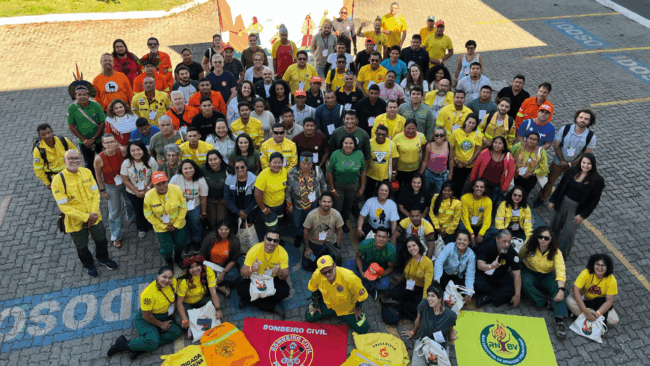
Over three days, representatives of more than 120 brigades from across Brazil gathered in an unprecedented national meeting. These brigadiers know their territories like no one else. They understand where the wind shifts, where the fire tends to spread, and the right time to carry out prescribed burns to prevent larger fires.
Brigade work begins long before the flames. Brigadiers clear forest floors in strategic areas, creating firebreaks to stop the spread, educate communities on fire prevention, and monitor early warning signs. It’s a prevention effort that often goes unnoticed—but can stop a wildfire from starting in the first place.
When combat is necessary, they use radios, backpack water tanks, fire beaters, blowers, machetes—and increasingly, drones and GPS. But above all, they rely on collective wisdom and mutual trust. Because true brigadiers know fire doesn’t wait—and only collective action can stop it.
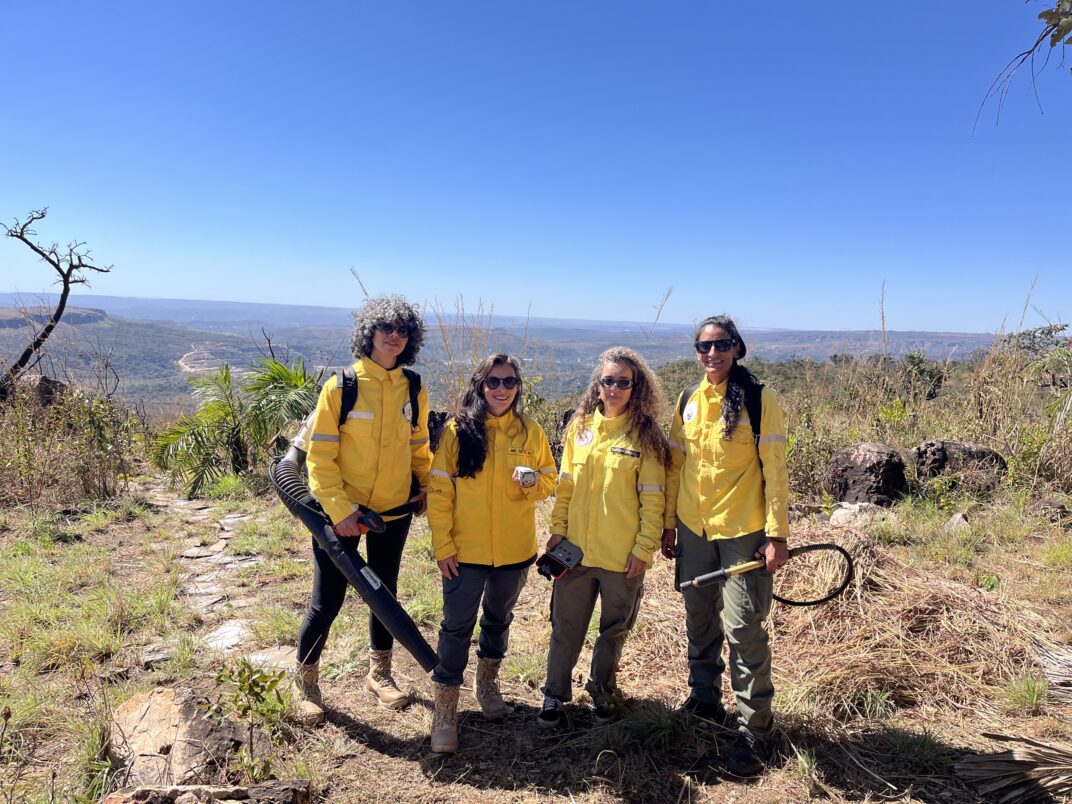
Women from the Guardiões da Cafuringa brigade (Federal District) in the field. Photo: Lucas Duarte
And that’s why the gathering wasn’t just about techniques and equipment — it was also about recognition. Despite being responsible for much of the fire prevention and containment work, these brigades still face a lack of funding, proper PPE, and sustained support, especially outside emergency periods.
Women played a central role throughout the event. Female brigade members from across the country demonstrated that firefighting takes more than strength — it demands knowledge, sensitivity, and strong organization. Together, they reaffirmed that women’s leadership is essential to protecting territories and safeguarding life.
“We created the women’s brigade not only to protect our communities, but to care for life throughout our territory,” said Maria Aparecida Apinajé, leader of the Apinajé Women’s Brigade, formed by 52 Indigenous women in Tocantins. For her, being a brigade member is an extension of bem viver — “preserving the living homes of the forest, protecting medicinal plants, and keeping our language, spirituality, and culture alive.”
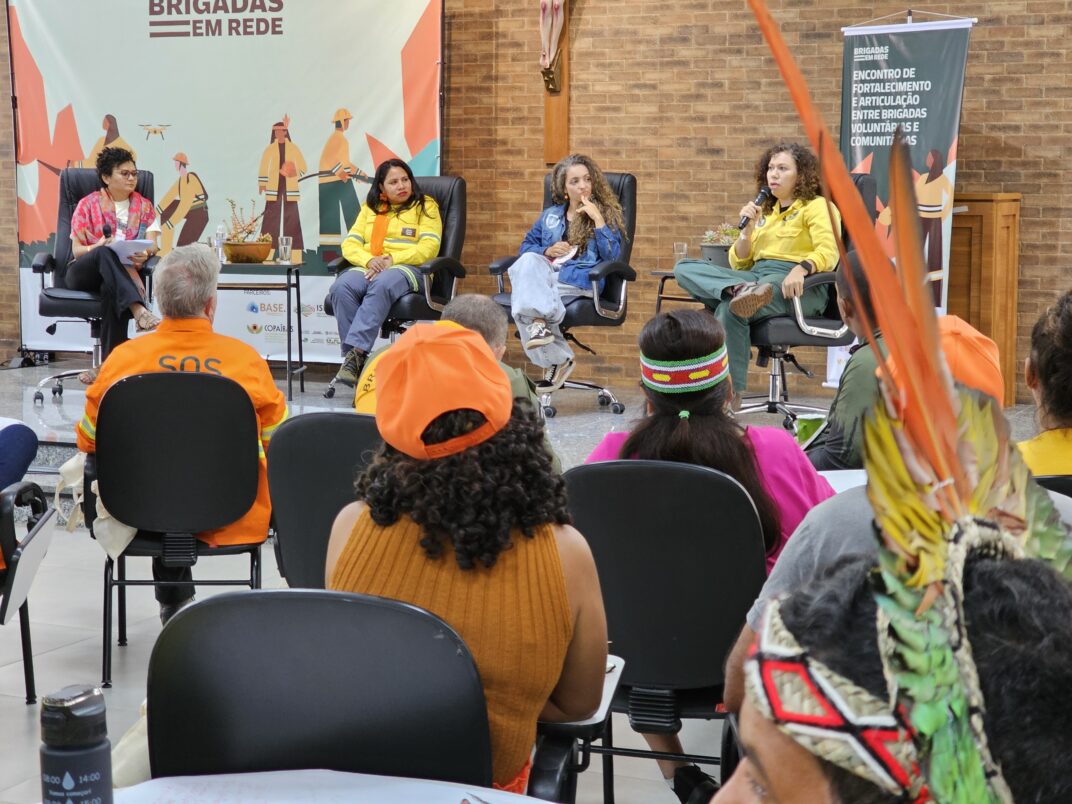
At the panel “The Importance of Volunteer Brigades and Women in This Work,” Maria Aparecida Apinajé, Maíz d’Assumpção, and Caroline Dantas highlighted women’s leadership in protecting territories. Photo: Camila Araújo (ISPN)
Other women, like Maíz d’Assumpção, Secretary Director of the National Network of Volunteer Brigades (RNBV), reminded us that this work must be recognized as a grassroots public policy—not as heroic improvisation. “Our category is still invisible. But we do much more than put out fires. We do prevention, environmental education, we build networks and cultivate leadership. We defend the territories like we defend our own homes—because that’s exactly what they are.”
And that’s exactly what these women do: they hold a fire beater in one hand and, in the other, carry children, stories, seeds, protocols, maps, and hope. That’s why they face fires when needed and manage fire responsibly—with knowledge, respect for the land, and a deep commitment to life.
The Challenges and Lessons of Integrated Fire Management in Brazil
Fire is not always the villain. For many, it’s a tool, a tradition, a means of survival. Brazil’s National Policy on Integrated Fire Management (PNMIF) was born from this understanding: it’s not enough to extinguish the flames—we must listen to those who have lived with fire for generations.
Imagine a farmer in the sertão or an Indigenous person in the Amazon. For them, fire is used to clear planting areas, renew pastures, or carry out ancestral rituals. But when mismanaged—or when the climate and deforestation spiral out of control—it becomes wildfire, destruction, emergency.
The PNMIF seeks to foster dialogue between science and tradition. Rather than banning fire, the goal is to understand how to use it strategically and safely, learning from those who have always known how to work with it. It’s a shift in mindset: fire management isn’t just about extinguishing—it’s about planning, respecting, and listening. It’s about learning from the forest and those who call it home.
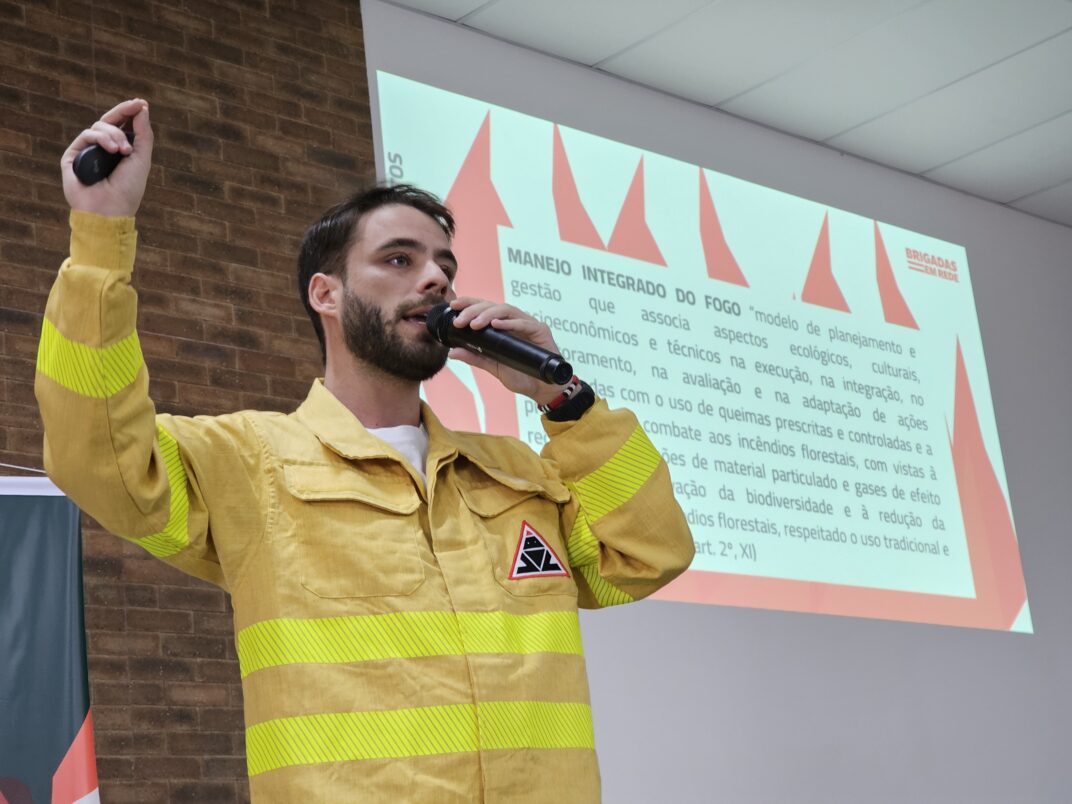
Gabriel Chaskelmann presents the National Policy on Integrated Fire Management (PNMIF), emphasizing that preventing wildfires requires planning, active listening, and recognition of brigades as professionals. Photo: Camila Araújo (ISPN)
For Gabriel Franco Chaskelmann, a brigade member of the Alter Brigade and one of the contributors to the development of the PNMIF, fire management is much more than the so-called prescribed burning. “Prescribed burning is just one of the tools of IFM. Management is much broader,” he explains.
“Doing IFM means looking at all of this. If an action ignores these factors, it’s not IFM — even if it uses fire. Some people are calling any fire use IFM. That’s not management. That’s risk,” Gabriel warns. For him, real prevention requires continuity and structure: “Prevention needs presence in the territory, listening to the community, and strategy.”
One of the policy’s strengths is the operational plan, which organizes brigade members, equipment, risk areas, and response capacity. “If someone asks why we’re acting in a specific area, we show them the plan. It backs our work,” he says.
Gabriel also advocates that brigades play technical, educational, and political roles in the territories and must be granted recognition and rights, such as life insurance. “They offered adventure insurance. I refused. Being a brigade member is not an adventure — it’s a way of living and protecting our territory. That’s why we demanded life insurance. And we got it.”
For him, strengthening fire management also means investing in training and knowledge-sharing. “The PNMIF guidebook was created so that everyone can understand what IFM is. Only through knowledge can we strengthen what we already practice.”
The message is simple: fire can be responsibly managed — if there is listening, organization, and respect for those who have always known how to use it without destroying the forest. It means sitting down with communities, understanding their knowledge, helping build a plan: simple, direct, with a map, calendar, and strategy. It means involving government technicians, firefighters, and local leadership. It means looking at the forest and asking: what does it need?
Congresswoman Célia Xakriabá participates in a meeting with brigades and reinforces the importance of formally recognizing wildland firefighting as a profession.
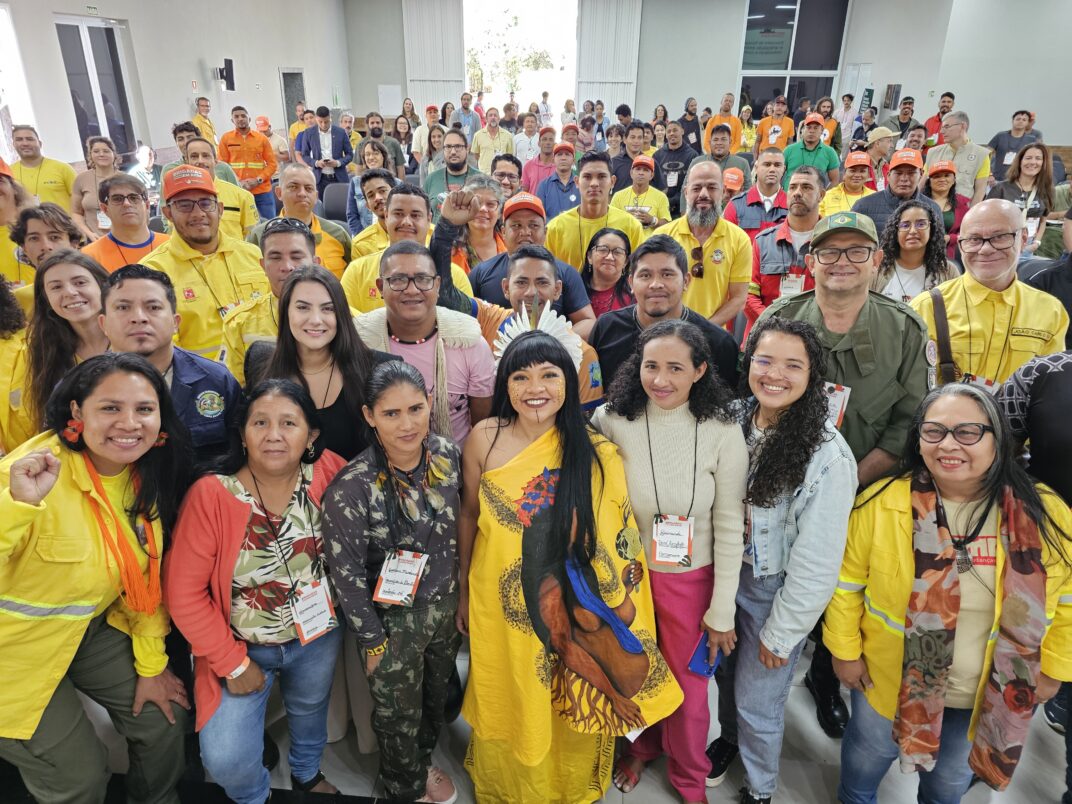
Congresswoman Célia Xakriabá attended the brigade gathering and advocated for the official recognition of wildland firefighting as a profession. Photo: Camila Araújo (ISPN)
Federal Congresswoman Célia Xakriabá (PSOL-MG) participated in the national gathering of Indigenous and community brigades, where she presented Bill 3621/2024, which proposes the creation and regulation of the Wildland Firefighter profession in Brazil. The proposal officially recognizes the work of brigade members, guarantees their rights, and values traditional knowledge in fire management.
During her visit, the congresswoman met with brigade members from different regions and biomes, listened to their accounts of field challenges, and reaffirmed her commitment to supporting and protecting these professionals. “You are not volunteers. You are professionals. And the State needs to recognize that,” she stated.
The bill outlines specialized training, medical and psychological assistance, life insurance, and the inclusion of traditional communities in wildfire prevention and response strategies. For the participants, her presence was a powerful signal that the voices of brigades are beginning to echo in Brasília.
Strengthening those who protect: the importance of direct support to brigades and community-based climate solutions
The climate crisis is not a future problem—it is a present emergency. And if there is one investment with both immediate and long-term impact, it is structural support for community and volunteer brigades. This means funding not just emergency actions, but also ongoing training, equipment purchases, maintenance of local infrastructure, and strengthening of regional networks. Above all, it means recognizing that those who protect the forest are also safeguarding our water, our air, and our very ability to exist tomorrow.
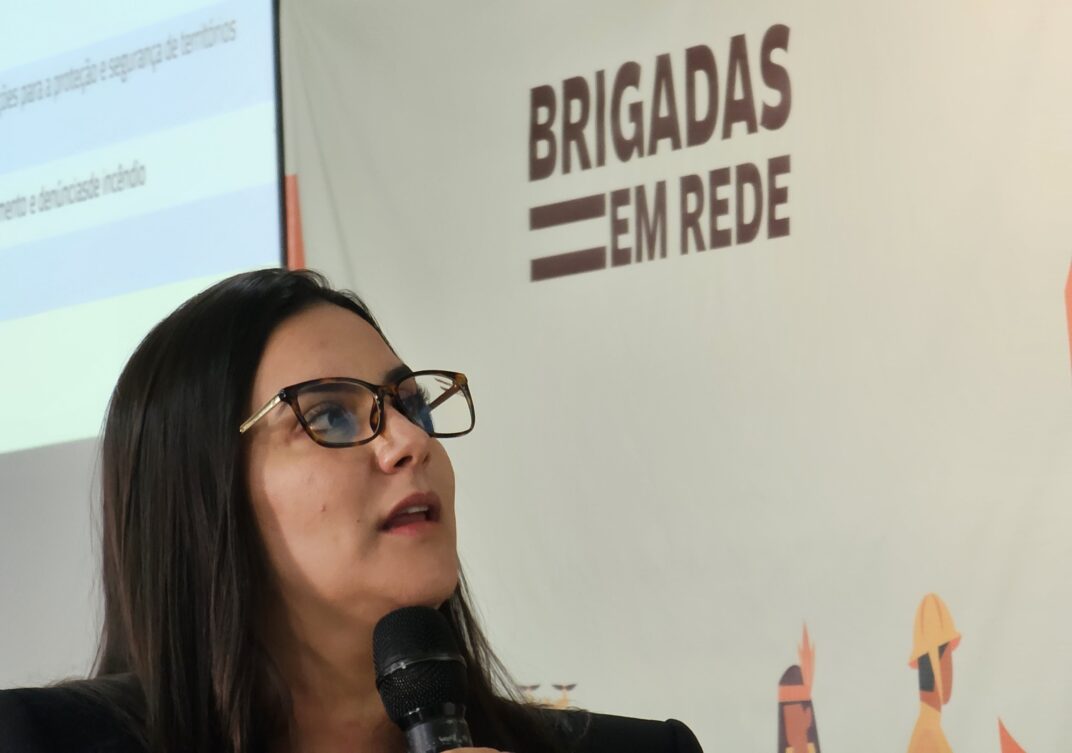
Beatriz Roseiro, from the Casa Socio-Environmental Fund, highlights the importance of direct support to brigades as a climate justice strategy. Photo: Camila Araújo (ISPN)
The experience of the Casa Socio-Environmental Fund has shown, for 20 years, that addressing the climate crisis must begin with those who already hold the solutions. And these solutions are born in the territories, grounded in traditional knowledge, collective action, and a deep commitment to life. That is why direct support to brigades is also a strategy for climate justice.
“We know the impact this work has. On a global level, these actions reduce greenhouse gas emissions, protect biodiversity, and contribute to the planet’s climate balance. But above all, it is work driven by love for the territory. What we witnessed during these days was the power of a network built on trust, listening, and peer-to-peer collaboration,” says Beatriz Roseiro, Program Manager at the Casa Fund.
With support from national and international funders, the Casa Fund has been able to strengthen local initiatives through flexible funding and listening processes adapted to the realities of each community. The importance of this direct support was reaffirmed by Vanessa Lucena, a representative of Bem-Te-Vi Diversidade, one of the funders present at the gathering.
“Our support is very small compared to what you actually do, to what you give. The health, time, and energy invested by each brigade member in the territories is something that inspires us. We seek to enable pathways, support processes, but the greatest leadership is yours—those making it happen on the ground,” says Vanessa Lucena.
Supporting brigades means investing in solutions that work. It means recognizing the wisdom of those who care for their territories as a way of life. And above all, it means ensuring that the fight against wildfires begins before the smoke—through structure, continuity, and justice.
Public policy must include brigades as a central part of the climate crisis response strategy. And mainstream climate financing must move beyond rhetoric and reach the places where it truly matters: the territories, and the hands of those already doing the work.