
 19.10.2026
Direct Funding for Those Rooted in Their Territories: Building an Anti-Nuclear Network in Brazil
Direct grants helped turn information, education, and collaboration into tools for public participation.
The future of nuclear energy in Brazil continues to be decided at construction sites, in government offices, and within technical bodies, but its effects extend far beyond these spaces. Across the country, civil society organizations are working to produce information, monitor public decisions, and enable communities affected by activities such as uranium mining to participate in the debate.
The debate has taken on new dimensions with the resumption of construction at Angra 3, in Rio de Janeiro. The plant, which will have a capacity of approximately 1,405 megawatts, has been under construction for decades and still requires around R$ 20 billion (approximately U$ 4 billion) to be completed, according to Eletronuclear, the company responsible for the nuclear power plants. In February 2026, an audit by Brazil’s Federal Court of Accounts (TCU) identified inconsistencies in the reference budget, insufficient funding, and the effects of repeated suspensions and resumptions of the project.
Beyond the debate over how much a nuclear power plant costs or how much energy it can generate, however, another question remains: who produces information about these projects, and who participates in decisions that affect the territories?
This is where the Articulação Antinuclear Brasileira (AAB, Brazilian Anti-Nuclear Network) comes in. Established in 2011, the network brings together civil society organizations, researchers, teachers, social movements, and activists. Since then, it has worked to expand public knowledge about nuclear activities in Brazil, their impacts, and alternatives for energy policy.
For Zoraide Cardoso Vilasboas, of AAB, one of the network’s first challenges was confronting the lack of information and transparency surrounding the sector. “At the beginning of our struggle, we identified that one of the main challenges would be to break through the barriers of secrecy, lack of transparency, and lack of public oversight that shield the nuclear sector,” she says.
She explains that the difficulty was not simply a lack of information produced by civil society. The public also knew little about the scale of nuclear activities in Brazil and their impacts.
Creating a national network made it possible to connect experiences across different territories. Bahia, Ceará, Pernambuco, Rio de Janeiro, Minas Gerais, São Paulo, and Goiás became part of a network working on several fronts. Rather than an organization focused on a single territory, AAB became a network capable of sharing information, bringing researchers and movements together, and organizing activities across different regions.
This was when direct grants to projects became especially important.
From Information to Collective Action
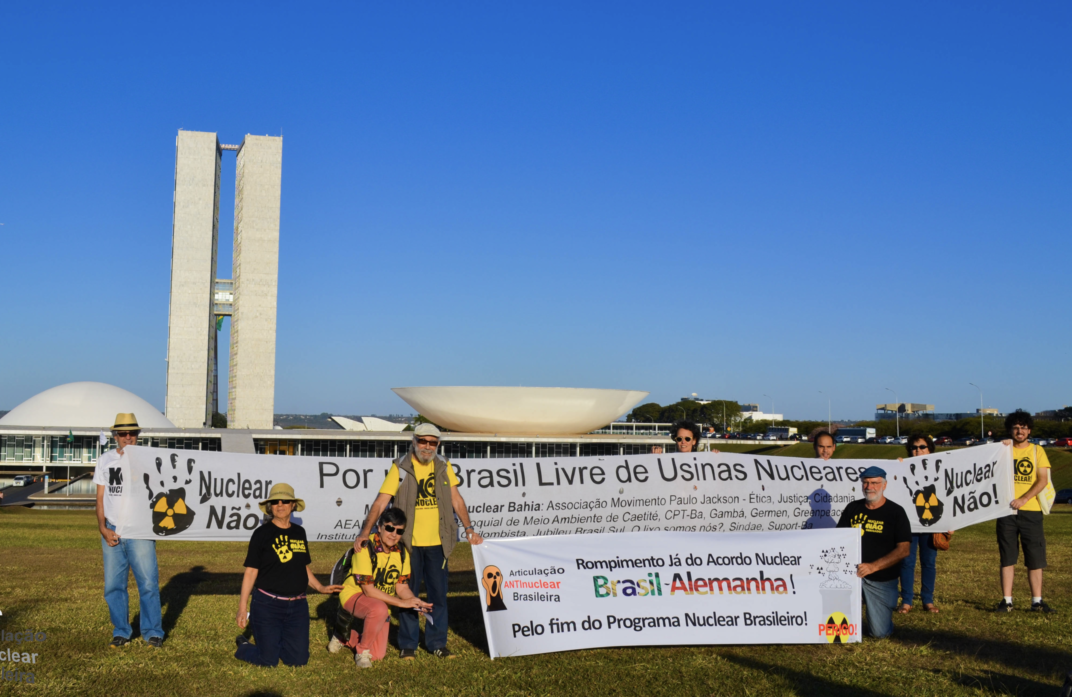
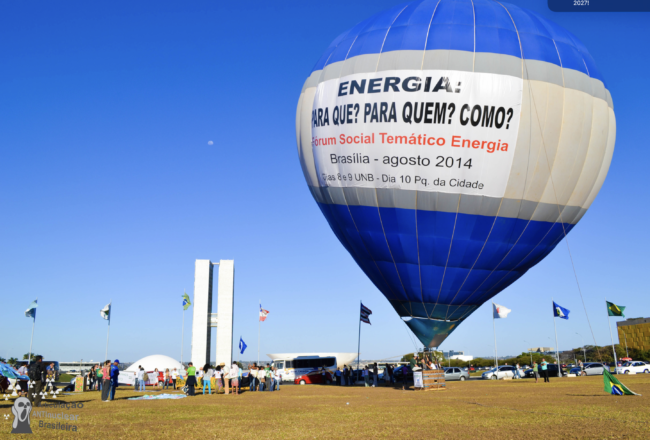
Members of Articulação Antinuclear Brasileira during the Fórum Social Temático – Energia (Thematic Social Forum – Energy), held in 2014. Photo: AAB Archive.
Over more than a decade, projects supported by Casa Socio-Environmental Fund and funded by the Mott Foundation helped strengthen Articulação Antinuclear Brasileira. During this period, a series of grants responded to changes in the network’s context and needs.
One of the first projects helped establish coordinated political action on nuclear issues in Brazil. According to Zoraide, the work led to initiatives that connected AAB with universities, researchers, and social organizations active in the territories.
In Caetité, Bahia, where uranium mining takes place, the network participated in an environmental learning initiative in partnership with the State University of Bahia, resulting in the production of 14 films. At other times, its work included producing educational and audiovisual materials. AAB developed a booklet and a documentary on anti-nuclear education, as well as gatherings for students, teachers, researchers, and social movements.
Communication also became a tool for advocacy. A project to create AAB’s Social Communication Network helped expand the network’s digital presence and bring content about nuclear issues to wider audiences.
For an organization working on a technical, controversial subject that often feels far removed from most people’s daily lives, producing and distributing information is not a secondary activity. It is a way to shape the public debate itself.
AAB identifies the production of informational materials, videos, booklets, campaigns, seminars, and dialogue circles in places where nuclear facilities exist or are planned as key strategies. “With support from Casa Fund, we have made progress in raising public awareness of nuclear technology and its risks,” says Zoraide.
What Remains After a Project Ends
Some project results can be measured by their deliverables: a documentary produced, an activity held, or a publication released. But the effects of support can also be seen in what continues to function after a project ends.
A communication network remains active; a group formed through an educational process may continue its work; researchers and organizations brought together may keep exchanging information; a documentary may be shown at a school years after it was produced; and connections built across territories may be mobilized in response to a new public decision. This continuity also helps explain AAB’s trajectory.
Through different supported projects, the organization experienced periods of institutional strengthening. In one initiative, for example, the project evaluation recorded that the network began with six facilitators and ended with 12 people working across different regions of the country, while also strengthening ties with groups working on environmental justice, mining, and health.
This trajectory is also reflected in the experiences of people who became involved in these projects and carried what they learned into other areas of anti-nuclear advocacy.
Maria Clara Valverde Sevalho, who now serves on the coordination support team of Sociedade Angrense de Proteção Ecológica (SAPÊ), coordinated Recultura in 2017. The project was carried out by SAPÊ in partnership with Organização dos Caiçaras e Amigos (OCA), with a R$ 20,000 grant (approximately U$ 4,000) from Casa Fund. In Frade, Angra dos Reis, the initiative emerged from a particular feature of the territory: the neighborhood lies within the nuclear plant’s five-kilometer Emergency Planning Zone. The project sought to strengthen Caiçara culture while engaging with the reality of nuclear risk.
The project produced the short documentary Recultura Caiçara, featuring testimonies from longtime residents about the community’s stories and legends and the changes brought by construction of the Rio-Santos highway and the nuclear power plants. It also brought the discussion into schools through socio-environmental activism workshops involving 181 students from two local public schools.
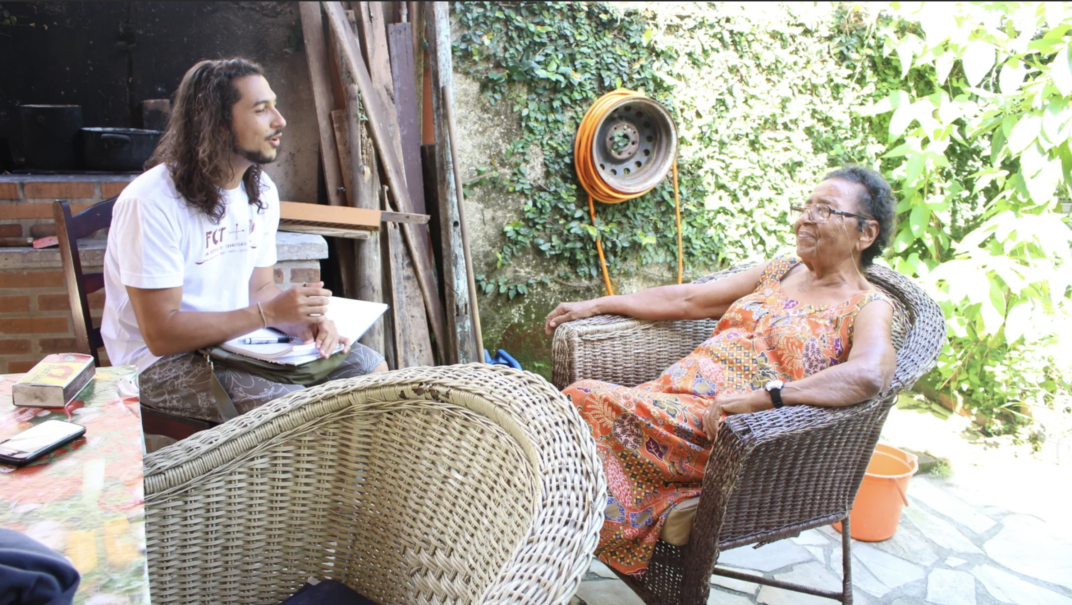
Dona Belzinha during an interview for the documentary Recultura, in Angra dos Reis, Rio de Janeiro, in 2017.
For Maria Clara, the project was a starting point for more structured involvement in the anti-nuclear movement. “It was through Casa Fund’s funding that my career as an anti-nuclear activist began in a professional sense—developing projects, participating in them, and working in a coordinated way,” she recalls.
Her experience illustrates a dimension of direct funding that does not necessarily appear in a project’s accountability and reporting: knowledge, relationships, and accumulated experience can continue to be mobilized long after an initiative ends.
For Zoraide, direct funding is particularly important because it gives organizations living with conflicts in their territories the material means to pursue their own work: “Funding institutions need to reflect on the importance of directly funding organizations that experience conflicts in their territories.”
This approach is different from funding only a one-off activity. Support enables organizations to set their own priorities, strengthen their work, and develop tools to address problems that often persist for years.
This is particularly important in conflicts involving major development projects. While decisions about construction, licensing, funding, and energy policy can take years, local organizations need to maintain their ability to monitor processes, inform their communities, and build alliances.
An Agenda That Remains Relevant
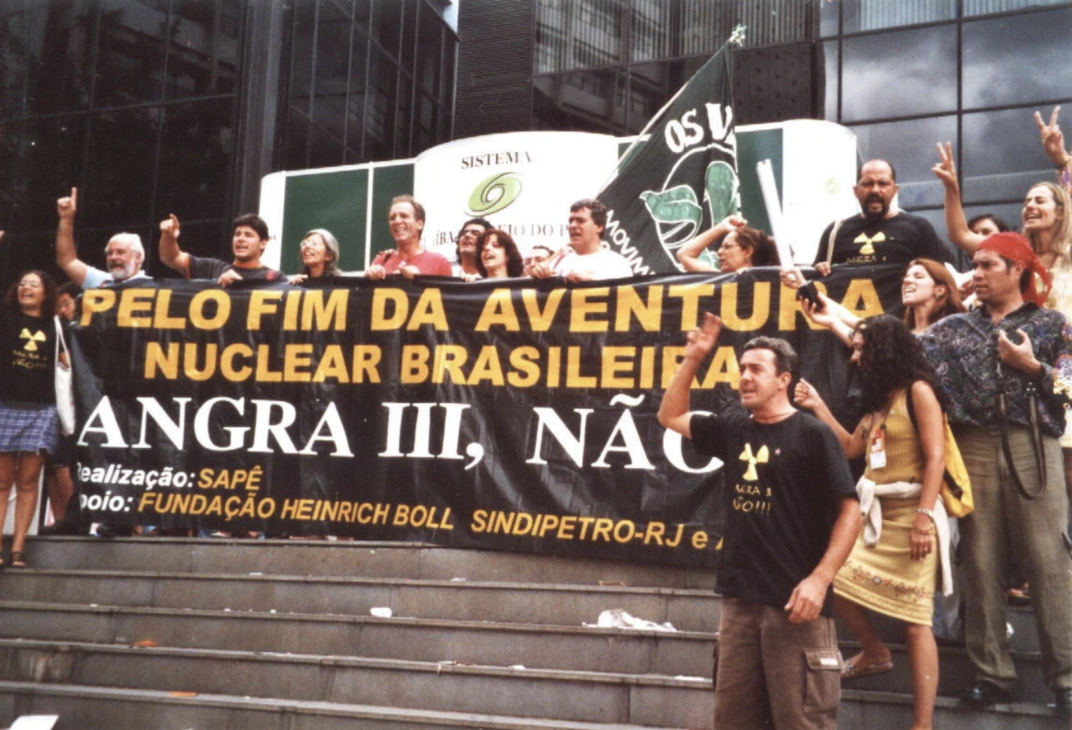
Demonstration against Angra 3 during the World Social Forum in Porto Alegre in 2002. Opposition to the project has continued through different stages of its history, from construction suspensions to attempts to resume work. SAPÊ Archive.
Brazil’s nuclear agenda is far from settled. Angra 3 remains at the center of decisions about public funding, electricity rates, and whether construction will continue. Meanwhile, other stages of the nuclear cycle continue to mobilize organizations and communities. AAB maintains connections in territories with mining activities, nuclear facilities, or proposals to expand the sector.
Against this backdrop, the network is entering a new phase. A recent project to expand anti-nuclear organizing in the Northeast aims to strengthen AAB’s presence in the region and bring organizations and activists in the territories closer together. This year, the grant also made possible a national gathering that had been planned for approximately four years. The event brought together people involved in anti-nuclear advocacy to discuss next steps and develop shared agendas.
According to Zoraide, the gathering was only possible because of the financial and technical support received through the project.
Socio-environmental funding supports action in the present while enabling organized civil society to continue working over the medium and long term. A nuclear power plant may be designed to operate for decades. A mine may transform a community’s relationship with its territory. In other words, decisions made today may have consequences across many territories for years to come.
It is with this long-term perspective that a network like AAB finds its purpose: remaining mobilized, producing knowledge, and influencing decisions whose consequences extend beyond the lifespan of any one project, government, or construction effort. This is also where climate philanthropy reaffirms its importance by strengthening efforts that uphold socio-environmental justice.