
 22.07.2026
From COP27 to COP31: How Casa Fund Turned Participation in the Climate Conferences into a Strategy to Strengthen Territorial Voices and Expand the Climate Finance Debate
In 2020, the international climate agenda began to take on a new scale. New financial commitments were gradually announced, philanthropy expanded its focus on the climate crisis, and the Conferences of the Parties (COPs) assumed an increasingly strategic role in shaping global decisions.
At the same time, a growing concern emerged within the Casa Socio-Environmental Fund. Although climate finance had become a central topic, discussions about the mechanisms through which these resources could actually reach community groups and local organizations were not advancing at the same pace. More importantly, there was a widespread lack of understanding about the financing structures that already existed across the Global South.
How could these structures be recognized and incorporated into both the official mechanisms of the UN Climate Convention and the commitments made by philanthropy and international cooperation? The answer was built over several years through learning, partnerships, and a deeper understanding of the spaces where major global decisions are made. One conclusion became clear: it was essential to be present, understand how these processes worked, and actively participate in the climate finance debate.
This journey gave rise to the Learning Journey, an ongoing training process that became part of a broader strategy focused on policy influence, leadership development, and the democratization of climate finance.
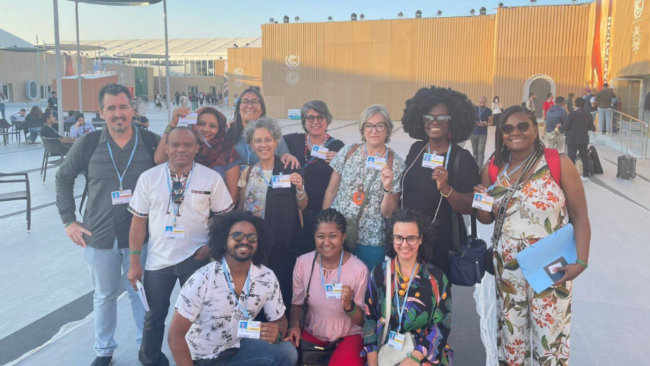
The first delegation organized by Casa Fund to a UN Climate Conference. Participation in COP27 marked the beginning of a strategy aimed at strengthening the influence of community-based organizations, territorial leaders, and partners in international negotiations.
A Decision That Changed the Way We Work
Casa Fund delegation at COP29 in Baku, Azerbaijan. The delegation brought together community leaders, civil society organizations, philanthropic representatives, and strategic partners, expanding the influence of local territories in international negotiations.
According to Cristina Orpheo, Executive Director of Casa Fund, the decision to develop a strategy for participating in the COPs emerged when climate issues became central to international philanthropy and global negotiations.
At that time, new financial commitments were being announced, and discussions about climate finance were gaining momentum. The key question was how to ensure these resources reached the organizations that protect forests, rivers, mangroves, savannas, urban peripheries, and other territories every single day.
“Casa Fund already knew the answer because we had been doing exactly that for many years. We developed mechanisms to support community organizations directly, quickly, and through relationships built on trust. When we realized that climate finance was becoming central to international discussions, we understood that our experience needed to become part of that conversation. It was not enough simply to attend the COPs. We needed to help transform the way these resources reach local territories.”
Cristina Orpheo
Executive Director, Casa Fund
Participate with Purpose
The COVID-19 pandemic delayed the first steps of this strategy. In 2021, the organization chose not to attend the COP in person out of responsibility and concern for public health. The period, however, was used to study how international climate negotiations function, deepen its understanding of climate finance, and develop its own approach to engagement.
When the delegation arrived at COP27 in Egypt in 2022, its objective was already clear. The goal was not simply to be present at an international conference, but to advocate for communities to no longer be viewed merely as beneficiaries of climate policies, but rather to be recognized as protagonists of climate solutions and legitimate actors in global decision-making.
“From the very beginning, we also understood that this could not be a strategy pursued by Casa Fund alone. If we believe that resources must reach communities, then those communities themselves need to be present in these spaces—presenting their priorities, building alliances, and engaging directly with funders and decision-makers. Likewise, strengthening other socio-environmental, community, and territorial funds was part of this transformation, as was raising the visibility of Global South funds and demonstrating that there is an entire field working to bring resources closer to local territories. Democratizing climate finance also means democratizing who gets to participate in decision-making.”
Cristina Orpheo
Executive Director, Casa Fund
It was from this understanding that the Learning Journey, the conference caravans, calls for proposals focused on strengthening climate advocacy, and a permanent strategy for training and collaboration were created. Their primary objective became creating the conditions for an increasing number of leaders to arrive at these spaces prepared to influence debates that directly affect their territories.
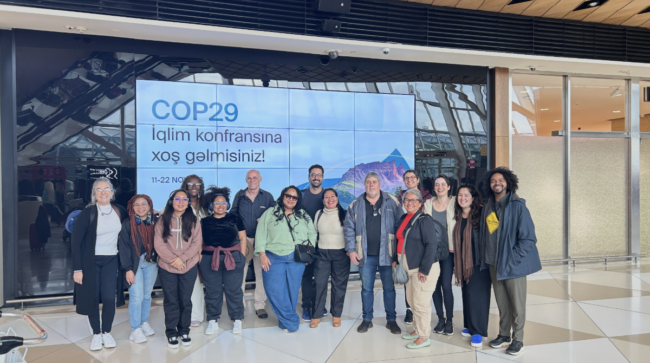
Casa Fund delegation at COP29 in Baku, Azerbaijan. The delegation brought together community leaders, civil society organizations, philanthropic representatives, and strategic partners, expanding the influence of local territories in international negotiations.
Participation Requires Preparation
The Learning Journey is a series of training workshops created in 2022 as part of Casa Fund’s strategy to strengthen the participation of community organizations, territorial leaders, philanthropic representatives, and partners in the Conferences of the Parties (COPs). It was designed to bridge the gap between global climate discussions and the realities of local communities, while preparing participants to engage effectively before, during, and after the conferences.
From its earliest editions, the methodology was developed in collaboration with Rubens Harry Born, who has followed international environmental governance for more than four decades. His contribution helped transform a topic often perceived as highly technical into a learning process grounded in the realities of community-based organizations.
“For a long time, there was a divide between those working at the local level and those engaged in global negotiations. During the 1992 Earth Summit, the slogan was ‘Think globally, act locally.’ But the reverse is equally true: we must also think locally and act globally. Those participating in international negotiations need to understand the realities of local territories, while those working in those territories also need to understand how these negotiations shape their lives and communities.” Rubens Harry Born – Founder of Casa Fund and Climate and Multilateral Environmental Agreements Specialist
The Learning Journey has built a bridge between the knowledge generated in local territories and international processes, demonstrating how decisions made during the COPs influence public policy, climate finance, and conservation strategies, while simultaneously strengthening organizations’ capacity to bring their own experiences and expertise into these global spaces.
Over the years, the Learning Journey has also broadened its scope. While its initial focus was on explaining how the international climate regime operates, the program now addresses topics such as climate finance, adaptation, biodiversity, energy transition, climate justice, transparency, strategic communications, and alliance building.
“The Learning Journey creates opportunities for dialogue among philanthropic organizations, grantee partners, government representatives, civil society organizations, and academics engaged in multilateral processes. This exchange of knowledge fosters a critical understanding of the relationship between local and global dynamics while preparing participants before they engage in international conferences. It’s much like planning a journey: before traveling, you need to know your itinerary, understand what to pack, and learn how to make the most of the experience.” Rubens Harry Born
The initiative also seeks to expand organizations’ capacity for advocacy by demonstrating that participation in the COPs extends far beyond the formal negotiation rooms. It includes building alliances, exchanging knowledge, and engaging in multiple spaces for dialogue throughout the entire process.
The diversity of organizations and leaders participating in the Learning Journey has become one of the initiative’s defining strengths. By bringing together Indigenous Peoples, quilombola communities, riverine communities, family farming organizations, community foundations, philanthropic institutions, and researchers, the program strengthens shared agendas while preserving the unique realities of each territory.
According to Rubens, this diversity of voices is essential.
“There are challenges we all share, such as addressing the climate crisis, but it is equally important not to lose sight of the unique characteristics of each group, community, and territory. The presence of diverse voices in advocacy spaces allows us to bring the distinct realities of local contexts together with the common challenges experienced across all territories.”
When Those Who Live in a Territory Speak on Its Behalf
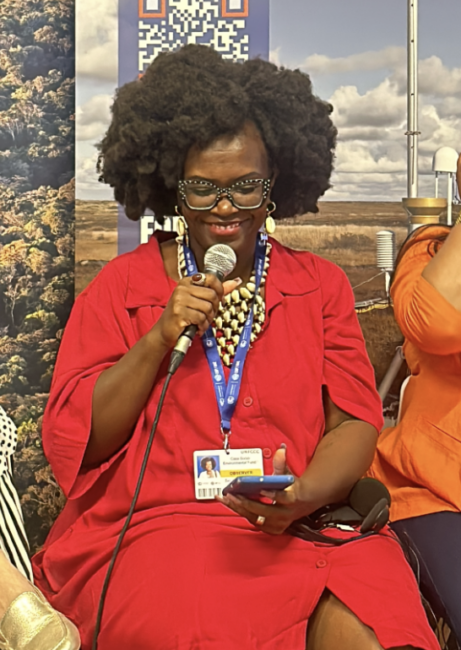
Selma Dealdina Mbaye, quilombola leader and member of CONAQ, during COP28 in Dubai. Present since the beginning of the strategy developed by Casa Fund, she helped establish the principle that territorial leadership should be at the center of participation in the UN Climate Conferences.
Among the leaders who have accompanied this process since its earliest years is Selma Dealdina Mbaye, current Chair of Casa Fund’s Board of Directors and one of Brazil’s leading quilombola movement leaders. Her experience illustrates one of the central objectives of the strategy: expanding the presence of people who have historically been excluded from international negotiations.
“When Casa Fund makes it possible for leaders from social movements to participate, it opens the door for them to experience these spaces, understand how they function, and occupy them with arguments, proposals, and solutions. Our body-territories must be present at the COPs—not only to speak about the problems we face, but also to present solutions. That has always been the defining characteristic of social movements.” Selma Dealdina Mbaye – Chair of the Board of Directors, Casa Fund.
Selma recalls that participating in a COP has never been simple. Access to accreditation, the high costs of travel, accommodation, and meals, as well as language barriers, often prevent precisely those who live in forests, along rivers, and in rural communities from attending. For this reason, she believes that preparing leaders before the conference is just as important as ensuring their participation during the event itself.
“It is essential to arrive prepared—to understand what a COP is, why it exists, and how the decisions made there affect the lives of our communities. We cannot allow decisions about our territories to be made without listening to those who live there. When people from our communities participate in the COP, it becomes a more democratic and more inclusive space.”
This understanding also evolved throughout Selma’s own journey. She explains that first-time participants often perceive the conference as distant, highly technical, and intimidating. Yet, in her view, this is precisely why social movements must continue occupying these spaces.
Over the years, Selma has learned that struggles extend far beyond national borders. Engaging with organizations from other countries, learning from different experiences, and building international alliances revealed that, although contexts vary, the challenges faced by Indigenous Peoples, quilombola communities, and other traditional communities are remarkably similar across the world.
Looking ahead, Selma envisions climate conferences that are more open to public participation and feature an even stronger presence of local communities in decision-making spaces.
“Our dream is to see more women, young people, Black people, Indigenous Peoples, quilombolas, and traditional communities occupying these spaces.”
“A truly democratic COP is one where people are no longer merely the subject of negotiations, but active participants in the decisions themselves. We must not be afraid of these spaces. Even when they seem overwhelming at first, we need to continue showing up, insisting on our place, and demonstrating that no one speaks more authentically for a territory than those who live there.”
A Milestone for Global South Philanthropy
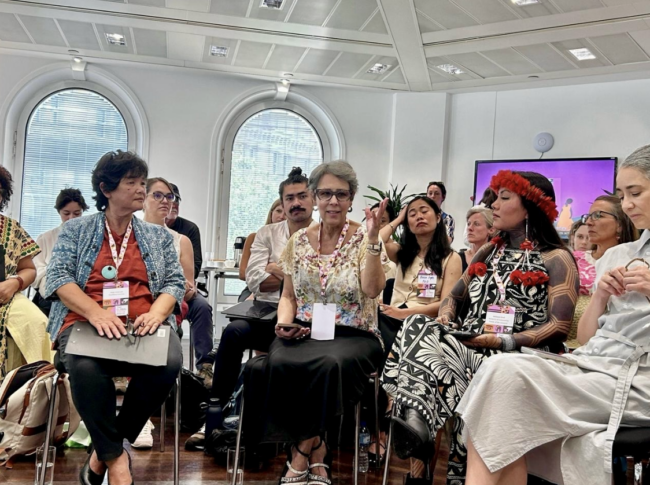
Maria Amalia Souza alongside representatives of Global South socio-environmental funds during a gathering organized by Casa Global South at London Climate Action Week. Among them is Josimara Baré, representing Indigenous funds.
The journey that Casa Fund has built through its participation in the UN Climate Conferences has also demonstrated that expanding the presence of territorial organizations in these spaces is directly connected to a broader transformation in the way climate finance is conceived and distributed.
Over the past several years, in addition to preparing leaders and supporting the participation of community-based organizations at the COPs, Casa Fund has helped strengthen networks and collaborative initiatives designed to bring financial resources closer to the communities that are on the front lines of protecting local territories.
COP30, held in Belém, represented a landmark moment in bringing these different initiatives together. The conference convened organizations supported by Casa Fund, community funds from the Amazon, members of the Rede Comuá (the network of Brazilian social justice philanthropic funds), the Socio-Environmental Funds of the Global South (a coalition of socio-environmental funds from Asia, Africa, and Latin America), and community funds from the Brazilian Amazon. Together, these organizations advanced a shared agenda focused on strengthening direct climate finance for local communities.
Within this context,The Global South House emerged as a platform for political engagement, collective mobilization, knowledge production, and collaboration among Global South philanthropic actors. The initiative seeks to strengthen the participation of these organizations in international debates on climate, nature, and climate finance.
According to Maria Amalia Souza, Founder and Director of Global Philanthropy Strategies at Casa Fund, this moment represented the culmination of work that had been built over many years.
“When I look at COP30 and see Global South socio-environmental funds gathered together—many of which we helped create, strengthen, or accompany throughout their development—I see the result of an enormous political investment. The creation of the Alianza Fondos del Sur, Rede Comuá, the strengthening of Amazonian community funds, and the establishment of The Global South House are all part of this process. We succeeded in bringing together 41 Global South funds in a dedicated space to discuss climate philanthropy from the perspective of our own realities.”
According to Maria Amalia, COP30 demonstrated the strength of a movement that has been built over decades and showed that community and territorial funds possess both the experience and the legitimacy to contribute to a new architecture for climate finance.
“The Global South is home to the world’s great forests, its largest rivers, its most extensive wetlands, and an essential share of global biodiversity. For that reason, our institutions must be recognized as the most legitimate, the fastest, and the most scalable pathways for ensuring that climate finance reaches communities. It is time for us to become protagonists in this process and to build stronger relationships of trust with major funders.”
Maria Amalia Souza
Founder and Director of Global Philanthropy Strategies, Casa Fund
This journey also reflects work that began even before Casa Fund itself was established—a long-term effort to reshape the narrative around philanthropy and emphasize the importance of supporting those who live in the territories where socio-environmental challenges are most acute.
“Our vision has always been that protecting life on Earth begins by strengthening the people who live in the territories that are simultaneously the most important and the most neglected by international philanthropy. At COP30, what was most significant was realizing that this agenda no longer depends solely on Casa Fund. It is now being carried forward collectively by a much broader network.”
For Maria Amalia, although there is still a long road ahead to transform the international climate finance system, the growing collaboration among community and territorial funds has strengthened their legitimacy and demonstrated the demand for new partnership models.
“We are not yet the first choice for international philanthropy, but we are building that legitimacy collectively. COP30 was another important step along that path. After the conference, we saw interest grow rapidly. During London Climate Action Week, for example, Casa Global South received more registrations than available places. This demonstrates a growing demand for a new approach to climate finance—one that is built by and with organizations from the Global South.”
The Next Chapter Begins Now
COP30 marked both an important milestone and the beginning of a new phase in this journey.
With COP31 in Türkiye and CBD COP17 approaching, Casa Fund is launching a new edition of the Learning Journey, expanding its scope to integrate both climate and biodiversity agendas.
Over the coming months, organizations supported by Casa Fund, members of Rede Comuá, and subject-matter experts will once again come together to explore the key issues shaping international negotiations, analyze the challenges that will dominate upcoming discussions, and develop strategies for engaging in the advocacy spaces that precede and accompany these conferences.
With each edition, the Learning Journey incorporates new lessons. Its themes evolve alongside international negotiations and the experiences of participating organizations. The program increasingly addresses issues such as climate finance, biodiversity, energy transition, adaptation, socio-environmental justice, and strengthening local organizations.
The initiative is designed to build lasting capacities. The relationships established, the knowledge exchanged, and the alliances forged throughout this process continue to generate impact long after each COP has concluded.
If, in 2020, the question was why an organization working directly with local communities should participate in international negotiations, today the answer has become part of Casa Fund’s own history.
Over the years, we have come to understand that strengthening communities also means creating the conditions for them to occupy the spaces where the policies, agreements, and financing mechanisms that directly shape their ways of life are discussed and decided.