
 09.07.2026
2025 Annual Report Shows Casa Fund’s Secong-largest Grant Cycle in History and Strengthens Communities’ Role in Responding to the Climate Crisis
With R$46.65 million directed to initiatives across Brazil, the Casa Fund expands direct support to community-based organizations and reaffirms that solutions to the climate crisis are already present in the territories
At a moment when the climate crisis is challenging the world to find new answers, communities across Brazil continue to show that many of these answers are already in practice. These are solutions built on local knowledge, collective organizing, and the commitment of those who have cared for their territories for generations.
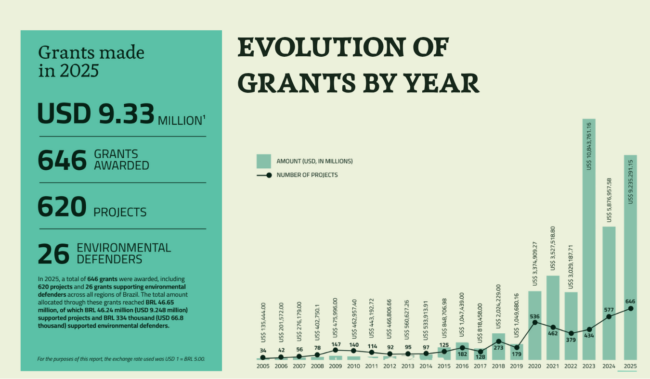
This is the reality captured in the Casa Socio-Environmental Fund’s 2025 Annual Report. The document brings together the past year’s key results and shows the largest volume of resources ever mobilized by the organization in more than twenty years of work. A total of R$46.65 million was directed to the direct support of socio-environmental initiatives across Brazil.
Throughout 2025, 646 grants were made — 620 community projects and 26 grants dedicated to protecting environmental defenders — strengthening organizations working on biome conservation, territorial rights protection, food security, income generation, and climate adaptation.
The data show that expanding support to communities also means expanding their capacity to face some of the country’s leading socio-environmental challenges.
Scaling Up Without Losing Proximity
One of the report’s central themes is that it is possible to significantly increase the volume of funding directed to community-based organizations without giving up proximity to the territories.
Throughout 2025, the Casa Fund launched nine large-scale calls for proposals, strengthening initiatives across all Brazilian biomes and expanding its work with traditional peoples and communities, local organizations, and territorial funds.
At the same time, it continued building relationships based on trust, listening, and the recognition that communities themselves are the leaders of the solutions they develop — a trait that has defined its trajectory since its founding.
The funding mobilized in 2025 reached territories facing some of the country’s greatest socio-environmental challenges. Indigenous Peoples received the largest share of support, with 155 initiatives strengthened, followed by family farmers (123 projects), activist citizens (125 grants), Quilombola and Afro-descendant communities (114 projects), as well as forest-dwellers, fisherfolk, riverine communities, Caiçara communities, and various other community-based organizations.
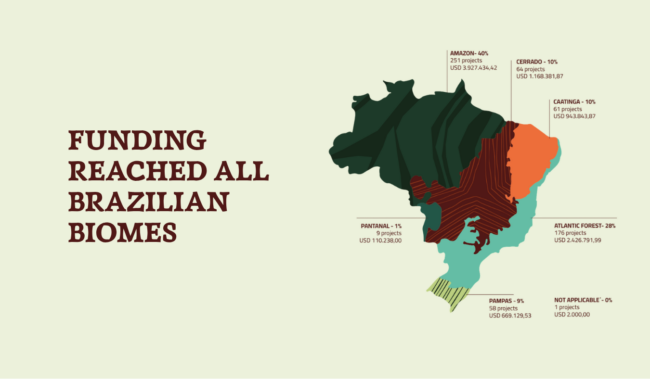
The Amazon had the largest number of supported projects (251), followed by the Atlantic Forest (176), Cerrado (64), Caatinga (61), Pampa (58), and Pantanal (9), reflecting work that reaches every Brazilian biome and recognizes the importance of each territory in addressing the climate crisis.
The impact of supported projects also grew in 2025. Initiatives strengthened by the Casa Fund reached more than 2 million people directly and approximately 4 million people indirectly, extending the effects of community-led actions far beyond the groups initially reached.
The projects work across different fronts, including institutional strengthening, territorial governance, Nature-based Solutions (NbS), sociobiodiversity enterprises, climate adaptation, community-based communication, sustainable agriculture, socio-environmental justice, and the protection of rights defenders.
Direct Funding as a Strategy to Address the Climate Crisis
The report also highlights a discussion increasingly present in international climate debates: increasing the volume of resources available to address the climate crisis is not enough — the way these resources reach territories must also change.
Throughout 2025, the Casa Fund expanded its work with community and territorial funds, strengthened Global South networks, and took part in strategic spaces on the international climate agenda, with a strong presence at COP30.
Experience accumulated over more than two decades shows that direct funding to local organizations expands communities’ capacity to respond, strengthens their autonomy, and contributes to a fairer distribution of resources allocated to environmental conservation and climate adaptation.
Although 2025 marked the Casa Fund’s largest grant cycle to date, the report notes that available resources still fall far short of existing demand.
During the year, the organization received 4,264 requests for support but was able to fund 620 initiatives — around 14.5% of the proposals submitted.
This figure reveals that thousands of solutions continue to be developed in the territories but are still awaiting access to the funding needed to scale their impact.
The 2025 Annual Report captures a year of growth for the Casa Fund, but above all, a year of strengthening for the communities that continue protecting their territories and building responses to the climate crisis. Each grant expands the possibilities for those who are already transforming reality every day.
Access the Casa Socio-Environmental Fund’s 2025 Annual Report