 24.09.2026
Waters That Meet to Strengthen the Territories of the Pan-Amazon
In Manaus (Brazil), funds from different countries and trajectories came together to strengthen connections, share experiences, and build new ways to get resources directly to communities across the Pan-Amazon.
Gourds filled with water were passed from hand to hand among participants in the gathering. Each person had brought a piece of their own territory to Manaus: water from rivers near their communities, from places where peoples and organizations live who have spent generations caring for the forest, defending their ways of life, and building responses to the challenges they face. In that symbolic moment, different parts of the Pan-Amazon began to meet.
The waters were poured into a traditional clay pot, itself carrying meaning of its own. The earth that nourishes — where people plant and build — now received the river waters brought by the participants. A gesture of connection to open three days of conversations about how to bring funds, funders, and community organizations closer together and get more resources to those in the territories.
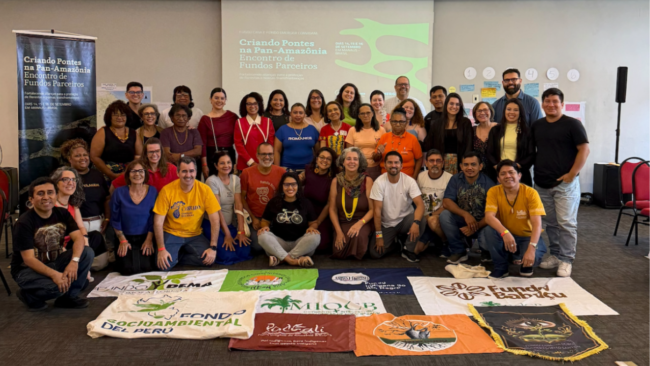
The ritual led by Angelo Ricardo Chaves, Program Manager at the Casa Socio-Environmental Fund, opened Criando Pontes na Pan-Amazônia — Encontro dos Fundos Parceiros (Building Bridges in the Pan-Amazon — Partner Funds Gathering), held in Manaus from September 14 to 16. About 50 representatives from 22 funds across different countries in the region came together to share experiences, discuss the challenges of direct funding, and build new forms of collaboration between those who mobilize resources and those who know, from daily experience, what communities need.
The choice of water was no accident. In Manaus, the meeting of the Rio Negro and the Solimões is one of the best-known images of the strength of the Amazonian rivers. They follow different paths, carry their own distinct characteristics, and run side by side until they form the Amazon River. For Angelo, the scene also conveyed what those funds were seeking to build together.
“This ritual of mixing, of meeting, of the convergence of the waters, represents the strength of the territories. It comes from one country, flows through several states, through several territories. It represents navigation, represents the union of peoples, represents the strength of the territories,” he explains.
In the clay pot, the waters could no longer be separated, but each one still carried the history of the place it came from. It was this diversity — gathered together without being erased — that participants would carry into the conversations of the days that followed.
Each Water Carries a Story
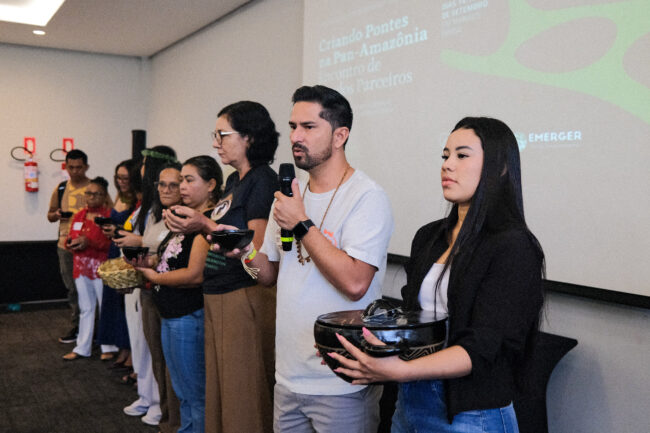
Photo: Attilio Zolin
Among the experiences brought together were community funds created out of social movements, Indigenous funds, socio-environmental organizations, human rights funds, and initiatives focused on different groups and territories. Some have decades of experience; others are still building their trajectories. The image of the rivers returned when participants left the meeting room to witness another meeting: that of the Rio Negro and the Solimões. Maria Amalia Souza, founder and Director of Global Philanthropy Strategies at Casa Fund, observed the two rivers and found in them a lesson for the funds themselves.
“These rivers are not the same. They have different speeds, different temperatures, and they blend together along the way. I think that’s the great lesson: we’re not the same either. Each fund plays a role within this larger ecosystem, but together we form one great, powerful river protecting the world’s largest tropical rainforest,” she said.
For Juan Camilo Mira, executive coordinator of Fondo Emerger, this diversity is one of the gathering’s great strengths. “The three networks present in Manaus have different origins, operate in different countries and regions, and were built out of their own trajectories. Even so, they share a vision of the need to mobilize more resources and power for community organizations in the territories.”
Where the Knowledge of the Territory Comes From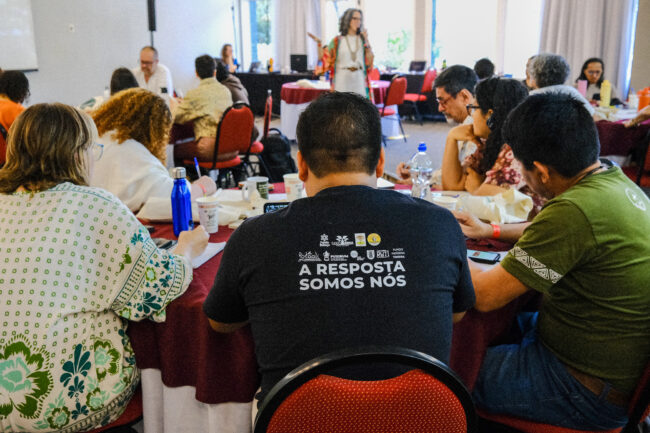
The differences also show up in the relationship each fund maintains with the territories and with direct funding itself. Within the Rede de Fundos Comunitários da Amazônia (the Amazon Community Funds Network), the nine funds that make up the alliance were created by social movements that were already active in those places. The leaders who go on to work at these funds carry that experience with them — knowledge of the communities and the needs of each region. Ellen Pereira, a representative of the network, explains that this closeness directly shapes how resources are used. The funds know the needs, know where the organizations are, and are able to support solutions that communities themselves are already building.
“The flow of money, of the resources that are raised, is much faster and much more efficient, because the funds are rooted in the territory,” Ellen says.
For Ellen, bringing these experiences closer together can help funds not only expand access to resources, but also influence how the funding system itself works. “How do we strengthen ourselves together to get these resources to the territories, while also influencing this funding system?” she asked.
For Maria Amalia Souza, this alliance only makes sense when it expands communities’ own capacity to lead the solutions built in their territories. “A handful of projects here won’t make a difference,” she says. “It will make a difference when all these communities, in every country across the Pan-Amazon, have access to resources to be the protagonists of their own solutions,” she points out.
Getting Resources There Is Part of the Transformation
Direct funding was at the center of discussion throughout the three days. Participants discussed where resources come from, what barriers still stand in the way of accessing them, and how to bring them closer to the communities working directly to protect the territories.
Community funds occupy a particular position along this path. They know local needs, have built relationships with community organizations, and at the same time, have built up experience engaging with different types of funders. For Ellen, this allows resources to be adapted to the concrete needs of each place — “so that the resource, the support, reaches the territories, but transformed, modified, and adapted to the reality we experience here.”
The discussion showed that direct funding is not just about cutting out intermediaries. It is also about bringing decisions on how resources are used closer to those who understand the problems, the relationships, and the solutions that already exist within communities.
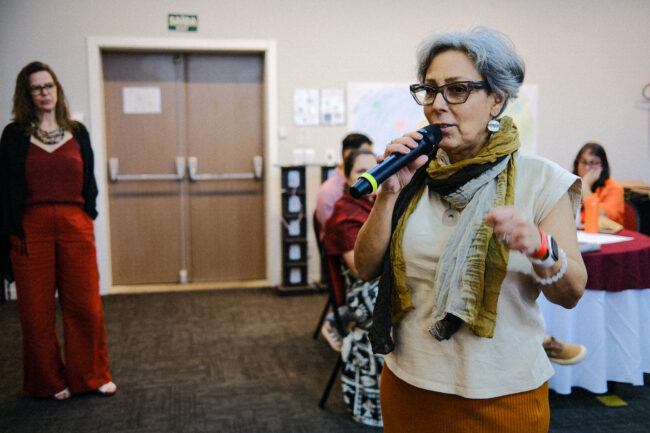
For Maria Amalia, one starting point is building trust among the different actors. “Knowing one another and building more trust among all the actors can, in the end, make a big difference — prioritizing that resources reach the hands of communities, the people who have been protecting this place for decades, for centuries, for millennia.”
This same building of trust also comes through in the words of Eduardo Franco Berton, founding director of Fundación Socioambiental Semilla, in Bolivia. For him, the funds share the same Pan-Amazon, but face different realities.
“The meeting of the waters — I think, metaphorically, it carries a very strong value for what we’re doing here,” Eduardo says. “Being here is also an example for the funds to get to know each other, to come together more, so we can have more strength to work in our own territories.”
An Alliance That Expands the Field
The connections built during the gathering in Manaus also point to challenges that go beyond what any single fund can tackle on its own. In sharing their experiences, participants talked about the barriers community organizations still face in accessing funding and sustaining their work.
For Jonathas Azevedo, coordinator of Rede Comuá, gatherings like this one help generate new forms of coordination beyond existing structures. “Spaces like this one, for strengthening networks and alliances, are essential not only as a strategy of resistance, but also for political organizing and for thinking through other paths, other possible structures for philanthropy and for the funding field, for the social struggle as a whole.”
Juan Camilo Mira sees in Casa Sul Global (The Global South House) a path to bringing networks closer together and deepening these relationships. “It’s a beautiful way to broaden the scope of the alliance with the Global South, to strengthen the relationship with Rede Comuá and with the Rede de Fundos Comunitários da Amazônia. It diversifies us, broadens our perspectives, and opens doors for very interesting discussions and learning.”
The hope, growing out of these exchanges, is that different experiences will keep circulating and can turn into joint action. It is about joining forces to take part in the discussions and help shape the paths that determine how resources reach communities.
The River Continues After the Gathering
The different trajectories that came together here don’t need to become the same in order to move forward together. Each fund carries with it the history and the lessons of its own territory, but also new connections, possibilities for partnership, and a willingness to build paths in common.
For Angelo Ricardo, this hope is tied to his own trajectory. Originally from an Extractive Reserve, and for years working with riverine communities, forest-dwellers, and family farmers in Pará and Amazonas, he knows firsthand the realities the funds are trying to support. “We are in the territories, we know the reality, we know how to make transformation happen, because we are in connection with the territories, with the organizations, with the peoples,” he says.
It is from this place of belonging that he looks toward what might come after this gathering. “I hope for many connections, a great coming-together, a great network of partners, of people who can unite to transform realities and provide the support communities need.”
The river continues on its way. Waters arriving from different places meet, share the journey, and then move on, each one carrying its own history, but knowing they are not alone.