
 04.11.2026
New Casa Fund Study Shows That the Community-Based Socio-Bioeconomy Transforms Local Realities and Needs Direct Funding to Grow
The publication analyzes the 405 projects supported by the Sociobiodiversity Web, which awarded R$40 million to organizations in every state in Brazil
Indigenous and Quilombola associations, family farming cooperatives, forest-dwellers, and artisanal fisherfolk are already producing, conserving, and generating income in every biome in Brazil. In most cases, what they lack is not knowledge or organization. It is an equipped community kitchen, a well for irrigation, processing equipment, working capital, or the legal paperwork and sanitary permits needed to operate.
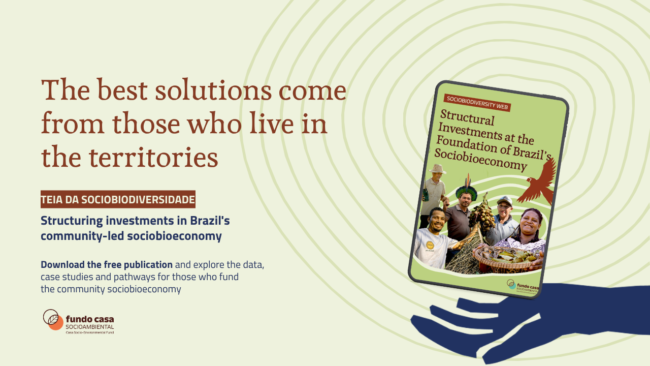
This is the main conclusion of Sociobiodiversity Web: Structural Investments at the Foundation of Brazil’s Sociobioeconomy, a new publication released by the Casa Socio-Environmental Fund. The study analyzes the portfolio of the Sociobiodiversity Web, an initiative carried out in partnership with the Fundo Socioambiental CAIXA (FSA CAIXA), and paints a picture of who drives the community-based socio-bioeconomy in Brazil, where they are, what they produce, and what they need.
“Brazil’s socio-bioeconomy is not waiting to be created. It already exists: it produces and conserves, generates income, feeds communities, and drives local markets,” says Cristina Orphêo, Executive Director of the Casa Fund.
R$40 Million Across Brazil, and Ten Times the Demand
Through two public calls for proposals, the Sociobiodiversity Web awarded R$40 million in direct grants to 405 projects, with up to R$100,000 per initiative. The funds reached all 27 federative units and 316 municipalities, about 6% of all municipalities in Brazil.
It is the largest financial commitment ever made by FSA CAIXA and the largest non-reimbursable funding the Casa Fund has received in its history. Since 2005, the Casa Fund has made more than 4,800 grants to community organizations.
“Direct grants should not be understood as small sums for small initiatives. They are structural investments in the foundation of local territorial economies,” Cristina Orphêo writes.
The two calls received 3,860 proposals, and only one in ten could be supported. For the Casa Fund, the more than 3,400 projects left out do not reveal a lack of initiative. Rather, they show that more resources need to be made available to fund projects in the territories. “The challenge is not finding initiatives or organizations capable of doing the work. They already exist, they are mobilized, and they know what they need. The challenge is getting funding to reach the scale required,” says the Executive Director. “This may be one of the most important political messages of this study.”
Who Makes Up the Web: Women, Traditional Peoples, and Organizations Rooted in Their Own Territories
The publication offers a portrait of the people behind the community-based socio-bioeconomy in Brazil. In nine out of ten projects, the organization receiving the funds is from the territory itself, which keeps money circulating in local economies. Most of the organizations are led by women (55.1%), underscoring women’s leadership in these initiatives.
The study also shows that many of these initiatives persist in territories under pressure from agribusiness, large infrastructure projects, mining, and energy developments, and it reveals how these pressures vary from one biome to another.
These organizations already produce and sell. More than half already supply food to school meal programs or public food procurement programs, and nearly all the others want to get there. What is missing, the study finds, is the next step: the conditions for this infrastructure to take hold and generate income on an ongoing basis. The publication details what these bottlenecks are, where they appear, and what the communities themselves propose to overcome them.
Five case studies show, in practice, what direct grants make possible in the territories. On Marajó Island (Pará), a cooperative is restoring degraded areas with agroforestry. In the Kalunga Quilombo (Goiás), an agro-industrial facility that had been idle for years is up and running again. In the Kambiwá Indigenous Territory (Pernambuco), women have secured the community kitchen they had been seeking for a long time. Completing the picture are young farmers in Rio Grande do Sul, with initiatives that help them stay on the land and generate income, and mariculturists in Arraial do Cabo (Rio de Janeiro), who have found a new source of income in seaweed.
Funding Those Already Doing the Work: The Path for the Socio-Bioeconomy to Scale
Photo: Ahmad Jarrah
Significant resources are being mobilized for climate, biodiversity, and the socio-bioeconomy. The Sociobiodiversity Web reveals the transformations that take place in local economies when this money actually reaches the hands of those who protect the territories, and it also identifies the bottlenecks that stand in the way. The experience of the two calls shows that it is possible to channel resources to hundreds of organizations at once when there is a bridge between funders and those on the front lines.
For the socio-bioeconomy to scale, the study proposes pathways for philanthropy, public banks, and impact investors, with funding that is more flexible, closer to the ground, and adapted to the rhythms of the communities.
“If we want a new economy capable of conserving biodiversity, tackling the climate crisis, producing food, generating income, and keeping value in the territories, we need to fund those who already do this work every day,” says Cristina Orphêo, Executive Director of the Casa Fund.