
 05.11.2025
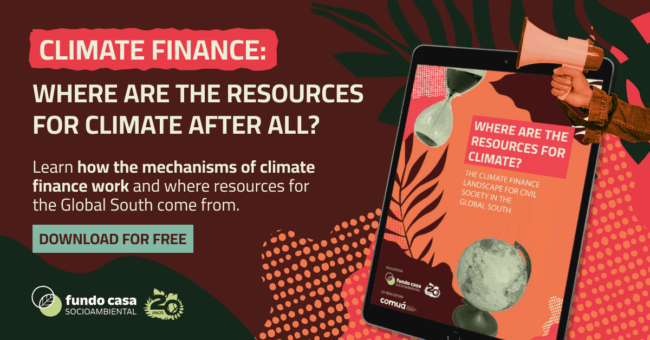
New publication “Where are the resources for climate?” deepens the debate on climate finance in the Global South
Produced by the Casa Socio-Environmental Fund, in co-publication with the Comuá Network, the new release presents data and analysis on financial flows and the challenges of democratizing access to climate resources.
What does it really mean to finance climate action with justice? And, more importantly: who has access to these resources — and who is still left out? The Casa Socio-Environmental Fund, in co-publication with the Comuá Network, launches the second publication in the series Building Climate Justice, titled “Where are the resources for climate? The climate finance landscape for civil society in the Global South”.
This is an unprecedented and in-depth study on the global architecture of climate finance — its mechanisms, challenges, and pathways to ensure that resources truly reach those who care for forests, waters, and sociobiodiversity. Written by Graciela Hopstein, with contributions from specialists and leaders in independent philanthropy, the publication delves into the contradictions and possibilities of the international financial system for climate — a field where trillions of dollars circulate every year, yet, according to the Global Landscape of Climate Finance (2023), less than 0.5% reaches the most vulnerable communities, precisely those leading the most effective, locally rooted solutions.
“There is plenty of money. The problem lies in the criteria, allocation methods, and governance of financial flows,” says Cristina Orpheo, Executive Director of the Casa Socio-Environmental Fund.
With a critical and accessible approach, the publication reveals how multilateral mechanisms, philanthropic funds, and even development banks continue to operate under centralized and opaque logics that exclude Indigenous Peoples, quilombola communities, riverine and rural populations, and urban peripheries — groups that not only endure the climate crisis but have long been creating and implementing nature-based and just transition solutions.
“Funds do not transform anything on their own. They support the communities that already hold the solutions,” reinforces Maria Amália Souza, founder of the casa fund and Director of Global Philanthropy Strategies, in her opening essay for the publication.
Throughout its chapters, the report brings together data, analysis, and reflections on international agreements, philanthropic mechanisms, blended finance, and global cooperation — while proposing concrete pathways to democratize access to climate funding. It also calls on governments, donors, and financial institutions to recognize that financing with justice means decentralizing decision-making, fostering collaboration, and placing territories at the center.
With 20 years of experience, the Casa Socio-Environmental Fund reaffirms, through this publication, the fundamental role of local, independent, and community funds in transforming the global financial logic — showing that the future of the climate depends on valuing the solutions that are already growing from the ground up.