 02.04.2026
Trust in territories that goes beyond rhetoric
With well-established trajectories, Selma Dealdina Mbaye and Laura Yawanawá take on the presidency and vice-presidency of the Casa Socio-Environmental Fund’s Board of Directors, guiding decision-making from those who build solutions
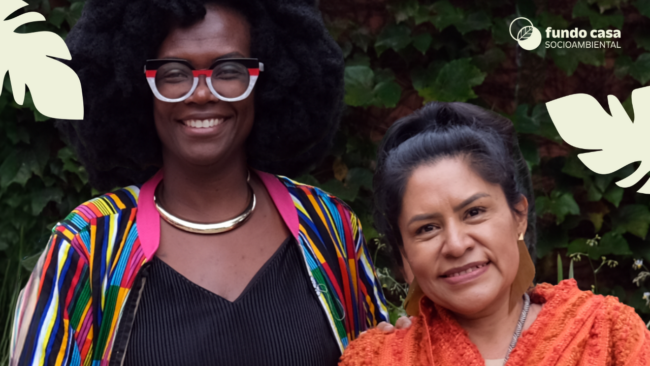
The Casa Socio-Environmental Fund was built on trust in the solutions that emerge from territories. This is how we have shaped our trajectory, and it is how we continue to organize our decision-making spaces. The election of Selma Dealdina Mbaye, a quilombola leader, as Chair of the Board, and Laura Yawanawá, an Indigenous leader, as Vice-Chair, held on March 26, brings to the forefront of the Fund’s main decision-making body two women who know this trajectory firsthand and are part of our history.
With paths rooted in their territories and direct engagement in socio-environmental agendas, Selma and Laura were already members of the Board and now take on its leadership, bringing to the center of decision-making the experience of those who live, articulate, and sustain, in their daily lives, the solutions that guide our work.
A quilombola woman from the Sapê do Norte territory in Espírito Santo, Selma Dealdina Mbaye has built her trajectory in the struggle for rights, political advocacy, and the strengthening of quilombola communities at the national level. A trained social worker, she serves as Executive Secretary of CONAQ (National Coordination for the Articulation of Rural Black Quilombola Communities) and is part of the National Collective of Quilombola Women. Upon assuming the presidency, she highlights the collective meaning of this role:
“Taking on the presidency and vice-presidency of this Board is carrying the history of two fundamental pillars in the construction of this country: Indigenous Peoples and quilombola communities. This position is not individual—it represents many trajectories of resistance,” she states.
For her, occupying this space is also about expanding paths already built: “we need to go beyond the role of implementation. It is essential to also be in spaces of power and decision-making. We hope this movement inspires other organizations to do the same, because that is how we transform realities.”
Alongside her, Laura Yawanawá, an Indigenous leader with Zapotec-Mixtec roots in Mexico, has built her trajectory advocating for the rights of Indigenous Peoples across Latin America. More than 27 years ago, after joining the Yawanawá people in Acre, she began working to strengthen women’s autonomy and community organization, contributing to meaningful changes in internal governance structures. With a background in international relations, she serves as Executive Director of the Yawanawá Sociocultural Association and develops initiatives related to Indigenous rights and climate change. As she takes on the vice-presidency, she brings to the Board a perspective deeply connected to collective life and ways of living:
“This Board, led by Indigenous and quilombola women, represents a very significant step in valuing perspectives that have historically been silenced. The presence of these women in leadership brings visions connected to territory, ancestry, and forms of organization that prioritize care, collectivity, and sustainability,” Laura emphasizes.
She also highlights the impact of this presence: “this strengthens communities and broadens the debate with greater diversity and justice. It is essential to recognize the autonomy of these leaders and their ability to build decisions based on their own realities.”
The presence of Selma and Laura in the leadership of the Board is not an exception in our history. It is the deepening of a path that began more than 20 years ago, with the founding of the organization by Maria Amalia Souza, who has always advocated that resources must reach—and be guided by—those who live in and protect territories.
“This is a very important milestone because it is consistent with everything the Casa Fund has built. We were born out of socio-environmental activism, working directly with those on the frontlines. Over the years, we have strengthened this relationship and brought these voices into the institution. Taking this step in governance today is a consequence of that process,” says Maria Amália.
For Cristina Orpheo, Executive Director, this moment reflects the maturity of a model built with consistency:
“The Casa Fund was structured on trust in the solutions that emerge from territories. Having leaders like Selma and Laura at the head of the Board further strengthens this direction, as it brings into decision-making spaces people with concrete experience, lived knowledge, and commitment to these agendas.”
Cristina also highlights the role of women in the organization’s trajectory:
“The Casa Fund is an organization built primarily by women, from its very origin. This is part of how we operate. These are women who have helped consolidate a strong institution, connected to territories and guided by a vision of socio-environmental justice.”
The new Board leadership is part of this path—it does not begin now. It is the continuation of a collective construction, built by many hands, which continue to work, sustain, and strengthen concrete solutions every day.
The new composition also includes Board members Gisele Paulino Reis de Oliveira, Mércia Consolação Silva, Elionice Conceição Sacramento, Brent Millikan, Esaltina Gonçalves Costa, Edmilson Carlos Pereira de Abreu Pinheiro, and Iremar Antonio Ferreira.
We extend our special thanks to Renato Cunha, who previously served as Chair of the Board, and to Severiá Idioriê Xavante, for their dedication, commitment, and fundamental contributions to building and strengthening this path over recent years.
With a nationwide presence, the Casa Fund continues to mobilize and allocate resources that strengthen local solutions led by communities with knowledge, experience, and a strong commitment to protecting Brazil’s biomes and ways of life.