
 06.07.2026
Beneath the Transmission Lines, a Territory Crossed: What Sítio Ágatha Reveals About Transmission Lines in Brazil
by Lucas Duarte Matos
In Pernambuco, the experience of Sítio Ágatha sheds light on how the expansion of transmission lines affects local territories and exposes the challenges of an energy transition that is still far from being just.
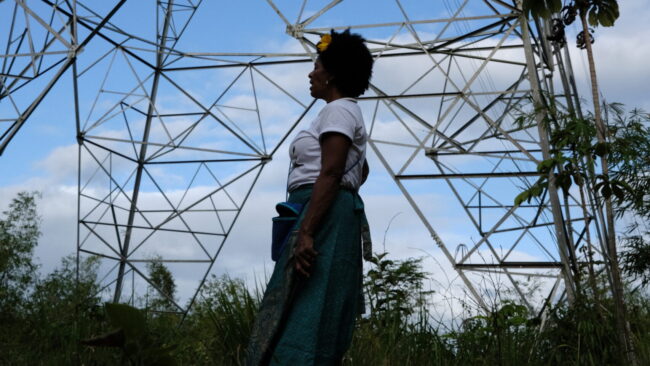
At Sítio Ágatha, everyday life persists despite the presence of transmission towers cutting across the landscape, sustained by care for the land, the memory of generations, and the strength of the women who continue cultivating life.
At Sítio Ágatha, a rural community in Tracunhaém, Pernambuco, energy has always been connected to life itself: to farming, community organizing, and the resilience of Black women farmers who sustain the territory.
In recent years, however, energy has arrived in a different form—through towers and power lines that cut across the landscape and reshape the community’s daily life.
“These transmission lines passed over our histories, our memories, our fields, and our ways of life,” says Jô Rodrigues, Director of Sítio Ágatha. “They revealed that many decisions about our territory are still made far away from the people who actually live here.”
Transmission lines are the infrastructure responsible for carrying electricity generated by large-scale energy projects to consumption centers. Essential to the operation of the power grid, they span vast distances and connect entire regions of the country.
The expansion of transmission lines has accompanied Brazil’s rapid growth in energy infrastructure. According to Brazil’s Ministry of Mines and Energy (2025), the country now has more than 190,000 kilometers of transmission lines in operation, a network that continues to expand in order to connect new power generation projects across different regions. This growth has been driven primarily by the expansion of large-scale wind and solar projects, especially in the Northeast and the Amazon region. As new energy plants come online, so does the demand for infrastructure capable of transmitting electricity over long distances to major consumption centers.
On maps of Brazil’s electrical system, these lines appear as strategic connections that strengthen energy security. On the ground, however, they cross farmland, forests, rivers, and entire communities, making discussions about prior consultation, public participation, and social and environmental safeguards increasingly urgent.
What may appear to be merely technical infrastructure is, in fact, part of a complex system of decision-making, implementation, and control—one that often remains far removed from the communities most directly affected.
“Today, transmission lines are awarded through auctions held on the stock exchange. Companies acquire the concessions and take control of these projects without any participation from the communities affected,” explains Luís Soares, Coordinator of Education and Research at Sítio Ágatha.
According to him, this model is structurally disconnected from the outset.
“There is no public participation during the auction process, and in many cases there is no meaningful participation during implementation either. This even contradicts ILO Convention 169, which guarantees Indigenous and traditional communities the right to free, prior, and informed consultation.”
At Sítio Ágatha, the experience with the transmission line exposed a clear gap between the protections that should exist for communities and what actually happens on the ground.
“We lack effective prior consultation, consistent social and environmental programs, and long-term monitoring,” says Luís Soares. “What arrives first are the towers, and with them come profound changes to local dynamics.”
The transmission corridor—known as the right-of-way—cuts across the territory and reshapes life around it. Productive land is affected, daily routines are altered, and decisions are made without direct dialogue with those who live there.
The reality experienced by Sítio Ágatha is not unique. Across Brazil, the expansion of transmission lines has accompanied the growth of major energy developments, including renewable energy projects such as wind and solar.
In the Amazon, these stories take on another dimension. Massive transmission corridors cross hundreds of kilometers of rainforest, passing through Indigenous territories and traditional communities. A recent example is the Manaus–Boa Vista transmission line, known as the Tucuruí Transmission Line, which began operating in 2025. Stretching more than 700 kilometers, it connects the state of Roraima to Brazil’s National Interconnected System and has been presented by the federal government as a major milestone in reducing the state’s dependence on diesel-generated electricity.
Yet, just as at Sítio Ágatha, the same questions emerge wherever these transmission lines pass: Who is consulted before construction begins? How are impacts on local territories addressed? And what role do communities have in decisions that directly affect their lives?
Ultimately, the distance between Pernambuco and the Amazon becomes much smaller when the same experience is repeated. Despite their different contexts, the challenge remains the same: ensuring that the energy flowing across the country respects the people who live along its path.
Where There Is Support, There Is a Response: The Path Built by Sítio Ágatha
Although often associated with the idea of sustainable development, this infrastructure does not always guarantee a truly just energy transition.
“It can reproduce longstanding forms of inequality, particularly in rural, Black, and traditional territories,” emphasizes Jô Rodrigues, Director of the project.
Faced with this reality, Sítio Ágatha began organizing to better understand and respond to the impacts of transmission lines. This is where support for community-led initiatives becomes decisive.
By strengthening its projects—including initiatives supported by the Casa Socio-Environmental Fund and funded by the Mott Foundation—the community has expanded its capacity to shape its own future. What was once experienced only as impact has become documentation, analysis, and policy advocacy.
“We began documenting the impacts, listening to residents, engaging with other affected communities, and developing proposals for social and environmental safeguards,” says Jô Rodrigues.
In practice, this means generating knowledge rooted in the territory, strengthening networks, and participating in debates about the future of Brazil’s energy policy.
For Luís Soares, “if the existing legal framework were properly enforced, many of these problems could be avoided. What is missing is ensuring prior consultation before the auctions even take place, as well as guaranteeing community participation in monitoring and social oversight throughout the entire process.”
Within this context, social and environmental safeguards emerge as essential mechanisms for protecting rights in large-scale infrastructure projects. These include free, prior, and informed consultation, transparency, and meaningful community participation in decision-making.
“A territory is not merely a corridor for transmitting electricity—it is a place of life, work, ancestry, and future.”
Jô Rodrigues, Director of Sítio Ágatha
The expansion of transmission lines in Brazil increasingly raises a fundamental question: how can the country ensure that the energy crossing its territory does not violate the rights of the people who live along its route?
At Sítio Ágatha, that answer is already beginning to take shape through community organizing, locally generated knowledge, and the conviction that the energy transition can only succeed if it is genuinely participatory and just.