
 29.04.2026
Xingu Stories: Collective Action in Defense of Territories
The Xingu is a living territory long before it was labeled an energy project. It is home, culture, and memory that span generations.
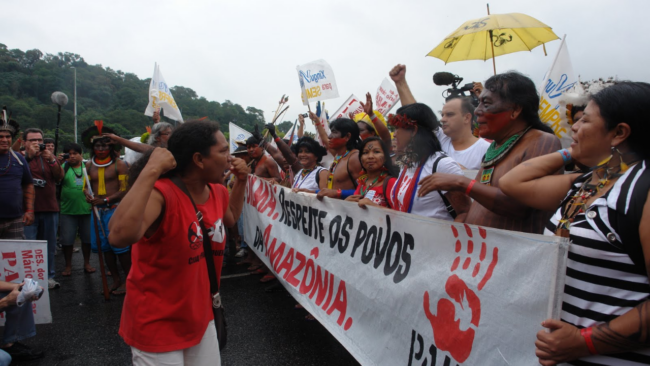
Long before the environmental licensing of the Belo Monte Hydroelectric Plant (PA), organized peoples, established alliances, and a network of support already connected forest communities with researchers, environmental defenders, and social movements in Brazil and beyond. When the dam was announced, it did not encounter an empty space. It encountered a territory. And territories have voices—and they respond.
In 1989, at the first Xingu Indigenous Peoples Meeting in Altamira (PA), leaders rose up against the dam complex, then known as Kararaô. In front of authorities from the electric sector, Tuíra Kayapó, an Indigenous and environmental activist, pressed a machete against the face of an Eletronorte director. The act, which gained global attention, became a symbol of territorial defense and made clear that the Xingu would not be decided without its peoples.
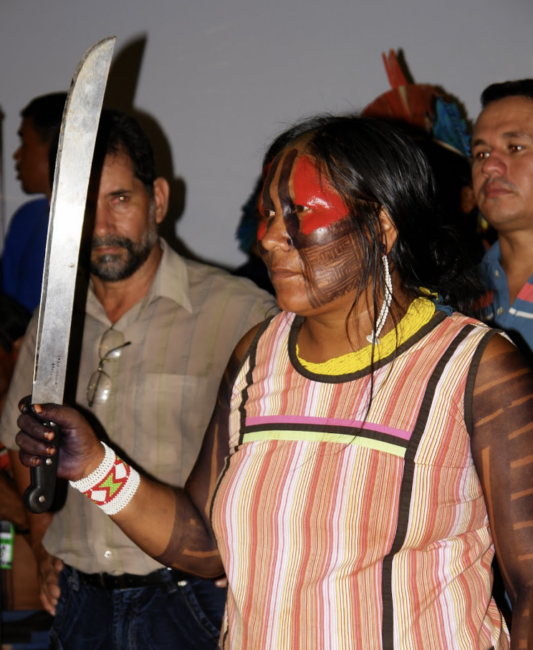
Tuíra Kayapó – Indigenous Leader of the Xingu | Photo: Xingu Vivo Movement Archive
Years later, in May 2008, another gathering would mark this history definitively. Indigenous peoples, riverine communities, farmers, social organizations, and supporters from across the country came together and gave a name to what already existed as a collective force. As Antônia Melo, a movement leader who has followed this trajectory from the beginning, recalls: “From that moment on, this movement in defense of the Xingu River, its peoples, and nature would be called the Xingu Vivo Para Sempre Movement. And that’s why we continue.”
The hydroelectric plant was built, but resistance continued. Diverting up to 80% of the Xingu’s water altered the territory, displaced families, and affected fishing, agriculture, and public health. Altamira grew in a disorganized way, and violence increased. This was called progress and clean energy—but on the ground, there were unmet conditions, unfulfilled promises, and losses that do not appear in official reports.
As Brent Millikan, former director of International Rivers in Brazil and currently a member of the Executive Secretariat of the Infrastructure and Socio-Environmental Justice Working Group (Brazilian Civil Society Network), notes: “neither a total success nor a total defeat. Belo Monte was imposed, but the mobilization continues. And these lessons are far too important to be forgotten.”
For Millikan, the Xingu’s history revealed the limits of an energy model driven by large-scale interests, “but also the strength of community organizing and alliances between Indigenous peoples, riverine communities, and social movements.”
Over the years, training, mobilization, monitoring, and communication projects have been supported in ways that strengthened existing capacities within the territory.
Today, a new threat looms over the Xingu’s Volta Grande: the Belo Sun mining project, which aims to establish the largest open-pit gold mine in the country in the same region already impacted by the dam. “The example of Belo Monte is enough,” organizations from the region stated in a recent manifesto. “We must unite to face yet another threat.”
Below, we share four stories of projects supported by the Casa Socio-Environmental Fund that help illustrate how the Xingu organized itself and how community and philanthropic support have been essential to this struggle and resistance.
1. The Xingu in action: gatherings that rebuilt alliances and defined strategies in response to Belo Monte
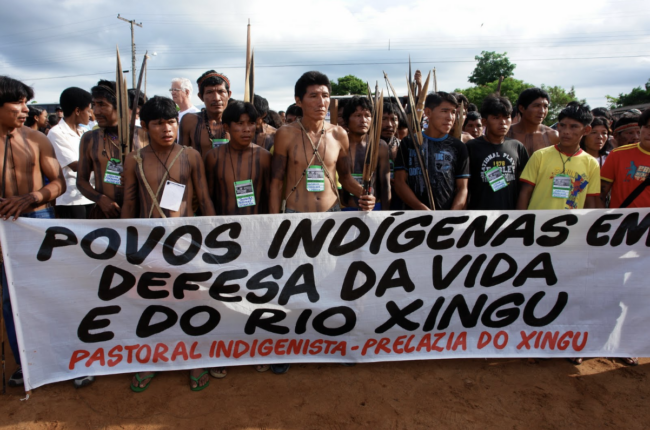
Photo: Xingu Vivo Movement Archive
After the Belo Monte auction in 2010, the Indigenous movement in the Xingu faced misinformation, communication challenges, and increasing political pressure—highlighting the need for reorganization. In response, the Xingu Vivo Para Sempre Movement organized the Meeting of Indigenous Peoples of the Xingu Basin on Belo Monte, bringing together around 200 leaders to align information, rebuild alliances, and define collective strategies in the licensing process.
The support received strengthened this capacity for coordination, enabling mobilization, travel for leaders, and participation in strategic spaces. It contributed to the movement’s presence at regional gatherings such as the regional Free Land Camp in Altamira and the Meeting of the Four Basins in Itaituba, which brought together around 500 representatives from the Xingu, Madeira, Tapajós, and Teles Pires rivers. It also enabled coordination with the Federal Public Prosecutor’s Office to monitor licensing conditions.
The main challenge was communication. The response was to expand grassroots work, invest in training, and strengthen leadership as information multipliers. Coordination was what sustained the movement in an adverse context.
“If it weren’t for the unity between Indigenous peoples, riverine communities, farmers, and social movements, this story would have been much harsher. What sustained us was our coordination,” says Antônia Melo.
Even after the dam’s construction, the organization remains active in supporting affected communities. “Belo Monte was built, but our struggle did not end. The river is still here, the peoples are still here, and the impacts are still here,” she adds.
2. Women on the frontlines of the fight for justice and reparations
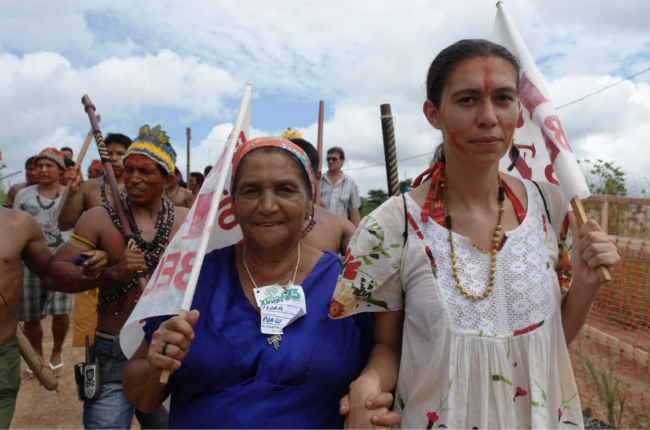
Photo: Xingu Vivo Movement Archive
When the turbines of the Belo Monte Hydroelectric Plant began operating, for those living in the territory, it marked the beginning of another phase. Removed homes, flooded islands, disrupted fishing, precarious urban resettlements, and loss of income hit families hard—especially women.
In this context, the Xingu Vivo Para Sempre Movement restructured its strategy and developed two projects. The first, “The fight for reparations: women’s leadership in confronting Belo Monte violations,” marked a shift from resistance to construction toward systematic demands for rights. It became necessary to map violations, organize complaints, and pursue legal pressure for accountability.
Visits to communities in the Volta Grande region, meetings with riverine and urban women, socio-environmental damage assessments, and formal complaints to public prosecutors revealed a central fact: women were at the forefront.
“As the complaints we received showed, it was the women themselves—especially single mothers—who came forward, because they were responsible for their households,” recalls Maria Elena Araújo.
She explains the strategic shift: “We had to pause, take a breath, and change course—sustaining the struggle alongside women. When roads were blocked and Norte Energia’s offices were occupied, women were on the frontlines.”
In 2019, new challenges emerged with the threat of mining and the weakening of public institutions defending rights. This led to a second project: “Support for coordination and organization among riverine families and urban women affected by Belo Monte and mining.”
The initiative connected women from urban resettlements, riverine communities, and movements along the Transamazon Highway. Workshops, regional coordination efforts, and women’s gatherings strengthened an Amazonian network for rights defense.
In a context of unemployment, rising violence, deteriorating health and education systems, and the collapse of fisheries, sustaining collective organization is itself a political act.
3. Territory, science, and rights: when the Xingu produces its own data and responses
In the Middle Xingu, two projects launched from 2019 onward demonstrate how grassroots organization, data production, and institutional advocacy work together to defend the territory.
With the project “Independent monitoring of the impacts of Belo Monte on the water quality consumed by riverine communities,” families who returned to the riverbanks began documenting what they already observed: changes in water color and smell, declining fish stocks, and suspected contamination.
While official reports indicated normal conditions, communities chose to generate their own data.
“It is essential that we have our own databases and studies based on our own indicators. Their studies never show environmental impacts or consumption risks,” says Josefa Silva, a leader of the Altamira Riverine Council.
With technical support, collection points were established and periodic analyses conducted. The process strengthened coordination among communities and consolidated the Riverine Council as a political space.
At the same time, another project enabled Indigenous leaders from 12 affected territories to mobilize and engage with the Federal Public Prosecutor’s Office to demand compliance with licensing conditions related to territorial protection, health, and food security.
Both projects share a core principle: those who live in the territory must have a voice in what happens there.
4. Amazon Generation: new voices from the periphery in the energy debate
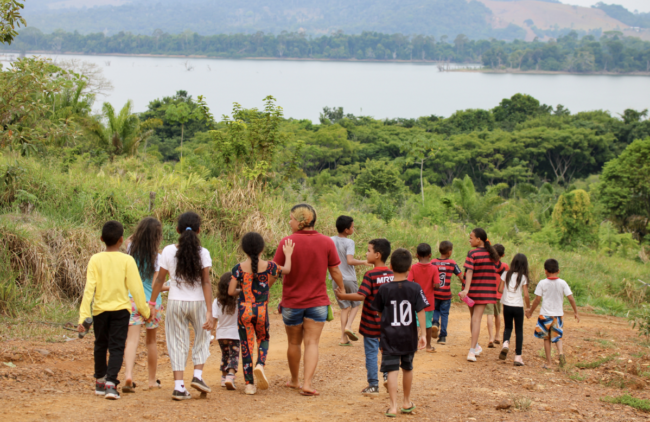
Children and youth participate in a training activity in Altamira (Pará), as part of an initiative by the Lilar Institute aimed at strengthening a sense of belonging and connection to the territory in the Middle Xingu.
Photo: Gabriel Santos de Sousa
If early mobilizations in the Xingu resisted the advance of dams, the new generation is growing up amid their impacts. In the Santa Benedita housing complex in Altamira, formed by families displaced by Belo Monte, adolescents who were children during construction are now asking their own questions.
In this context, the Lilar Institute developed the project “Amazon Generation: Training young peripheral leaders impacted by Belo Monte,” supported by the Casa Socio-Environmental Fund.
The initiative starts from a simple premise: those who will live the future of the territory must participate in decisions about it.
Young people engage in discussions on climate change, socio-environmental rights, and energy models. They also learn to use communication as a political tool, producing videos and a mini-documentary with their own proposals.
For this generation, energy transition is not an abstract concept—it is about jobs, territory, climate, and the right to remain.
In Brent Millikan’s assessment, what happened in the Xingu has gone beyond the region and reshaped debates on large hydroelectric projects in Brazil and worldwide.
Over the years, support from initiatives such as the Casa Socio-Environmental Fund has been essential in strengthening community mobilization and ensuring that their voices and strategies of resistance remain active.
For Antônia Melo, this partnership has tangible meaning: “Casa Fund is our great home—welcoming, committed, sensitive, always ready to respond and support the movement’s needs.”
As Millikan emphasizes, “solutions have always come from the territory. The role of allies is to strengthen those already on the frontlines.”
A resistance that produces data, builds networks, advocates politically, and preserves memory.
A struggle that did not begin with the dam—and will not end with it—because it is sustained by those who live in the territory and understand that remaining is itself a form of justice and recognition for those who protect the land and the environment.